Ferrari F430 Spider Interior Leather Restoration — New Jersey
A 2007 Ferrari F430 Spider arrived in New Jersey with a problem that is more common than it should be: both front seats had already been cosmetically refinished before the owner took delivery. The dealership's repair work had not matched the original Ferrari Cuoio leather. The corrected sections were noticeably darker than the surrounding factory interior — darker bolsters, darker edges, visible treatment boundaries in normal light. The owner's objective was to undo that work and return the seats to a correct OEM appearance, without replacing any original leather.
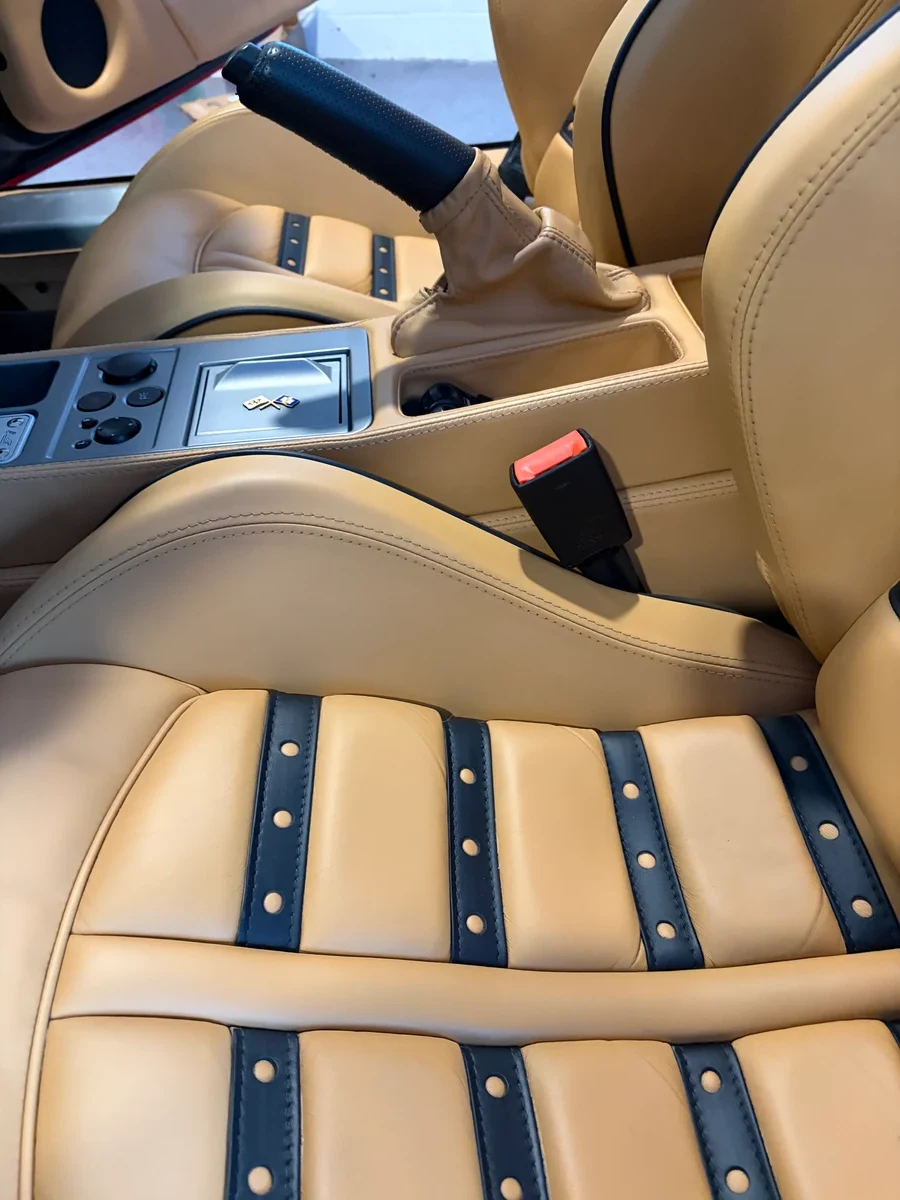
At a glance: Corrective leather restoration on a 2007 Ferrari F430 Spider with rare Daytona seats in New Jersey. The interior had been partially refinished by the selling dealership before delivery — the recolored sections did not match the original Ferrari Cuoio and were visibly darker than the surrounding leather. Restoration involved deep cleaning, removal of paint residue and overspray from the black Daytona inserts and piping, surface preparation and crack repair on the bolsters, individual masking of every Daytona insert, on-site development of a custom OEM Cuoio color match, airbrush refinishing of both seats, hand-restoration of the black piping using a fine artist's brush, and application of a reinforced UV-resistant protective top coat designed for convertible interiors. Approximately six hours of work. All original Ferrari leather preserved.
Project Overview
The Ferrari F430 Spider
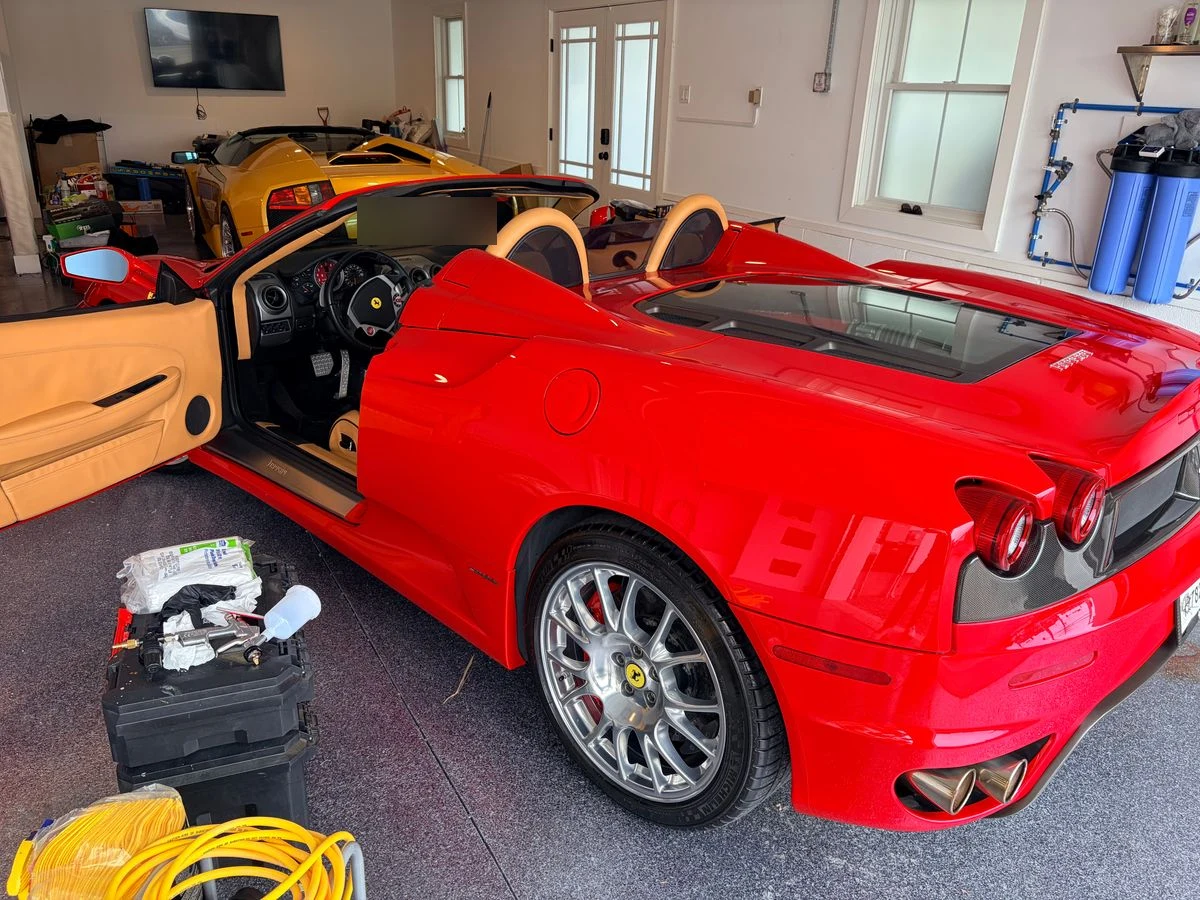
The Ferrari F430 was produced from 2004 to 2009 and represented a significant step forward from the 360 in terms of power, chassis dynamics, and aerodynamic development. The Spider variant — Ferrari's term for their convertibles — added an electrohydraulic retractable hard top, delivered in 20 seconds, with no meaningful structural compromise to the chassis rigidity established by the coupe. It was a car designed to be driven with the top down, and most owners do exactly that.
The consequence for the interior is straightforward: a Spider interior experiences more UV radiation, more ambient air movement, and more temperature cycling than a coupe in equivalent use. The leather ages faster under these conditions without proper maintenance, and any restoration work applied to a Spider must account for this elevated exposure.
The Interior: Daytona Seats
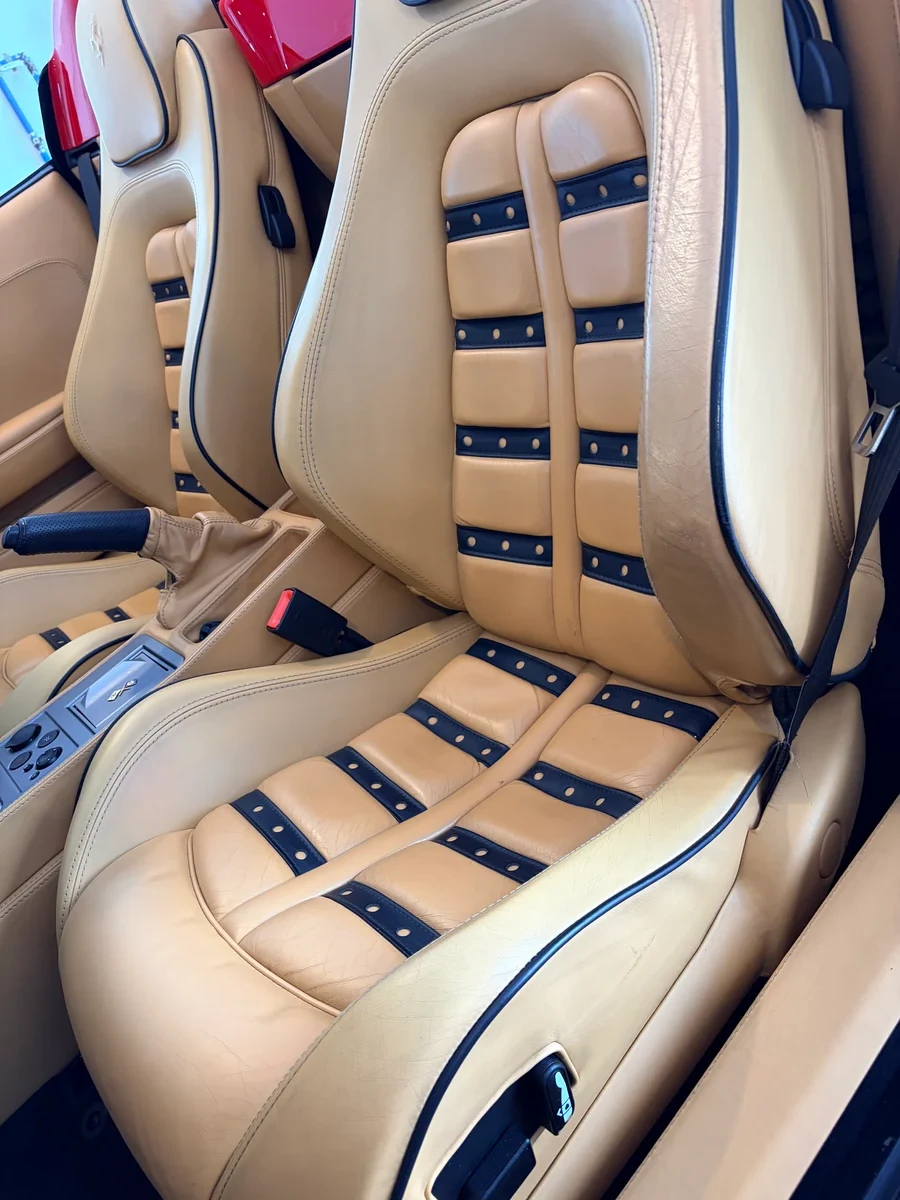
This F430 Spider was fitted with the Daytona seat option — a configuration significantly less common than the standard F430 bucket seats. The Daytona name references Ferrari's 1-2-3 finish at the 1967 Daytona 24 Hours, and the seat design itself has appeared across several Ferrari generations as an optional specification.
The Daytona seat pattern consists of horizontal leather inserts running across both the seat back and the seat cushion, each insert in black leather set against the main Cuoio body of the seat. Individual silver studs sit at each intersection point. The result is a seat with a visual rhythm that is distinctly Ferrari — more complex in construction than a standard bucket, and significantly more demanding to work on.
Each black insert must be individually masked before any color work can begin on the surrounding Cuoio leather. On a seat with multiple inserts across both back and cushion, this masking work alone adds considerable time to the job. It is not a step that can be approximated.
The Condition: What the Dealership Left Behind
The owner had purchased the car from a dealership. On the surface, the interior appeared to be in good condition — the Daytona seats retained their shape, the leather structure was sound, and there was no obvious damage. The problem only became apparent under closer inspection and in certain light conditions. Both front seats had been cosmetically refinished prior to delivery, with color applied to the outer bolsters, lower bolsters, and seat edges. The intent was to address wear on these high-contact areas. The result was a color mismatch.
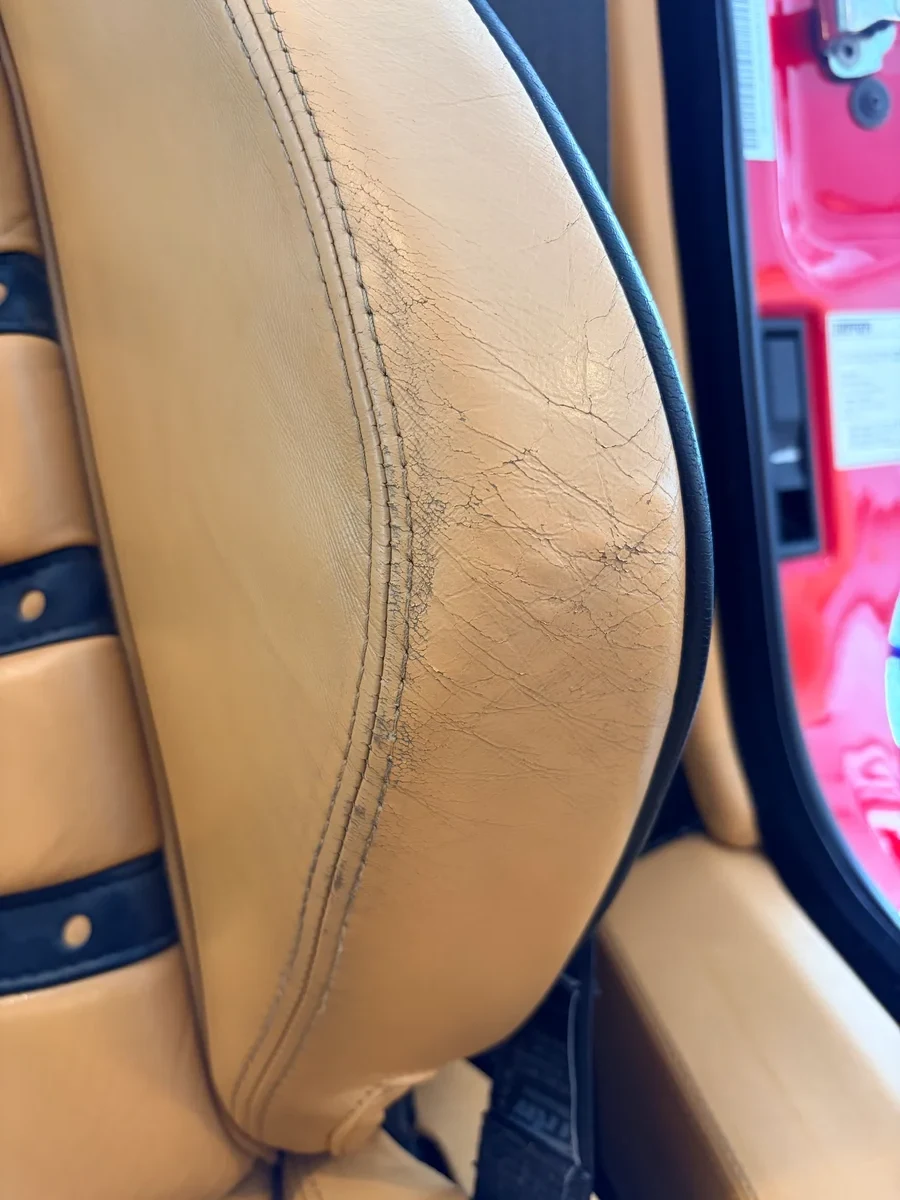
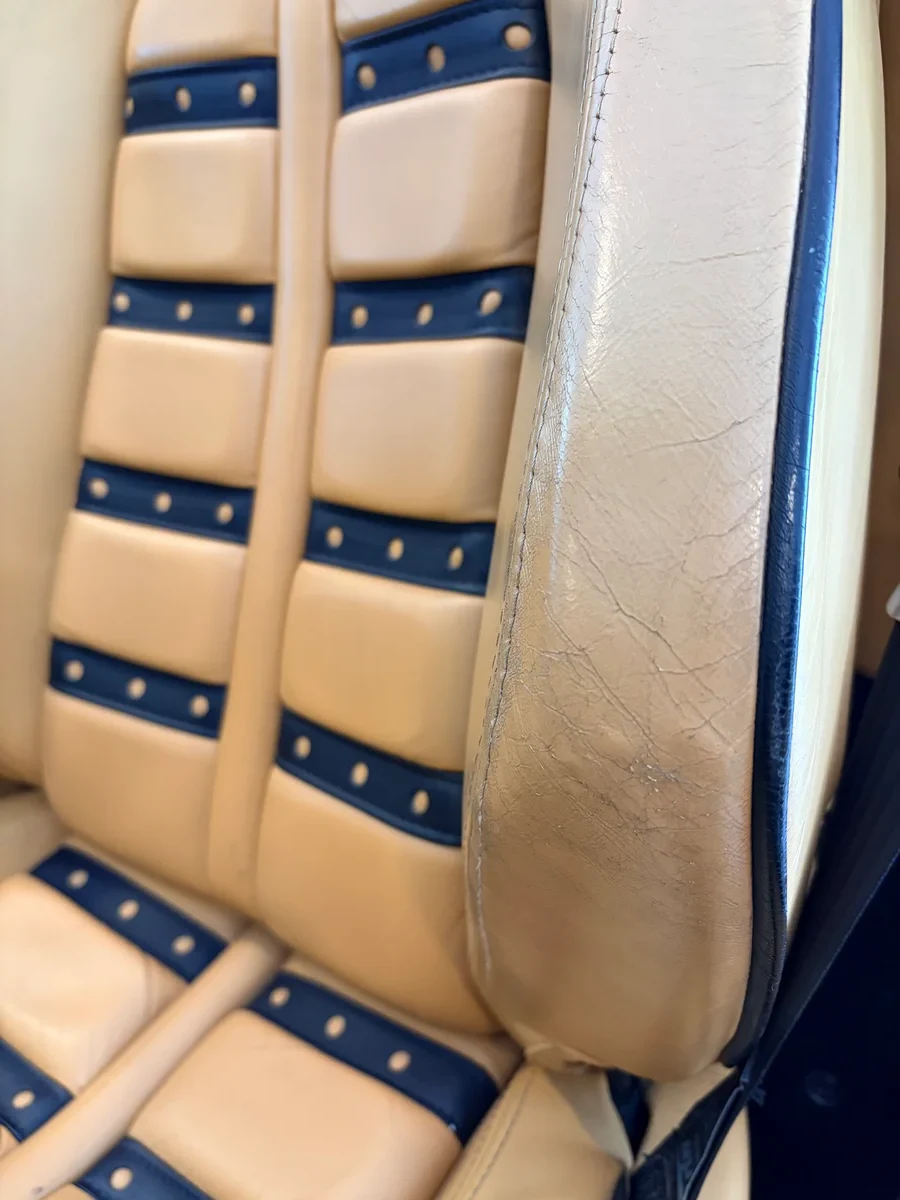
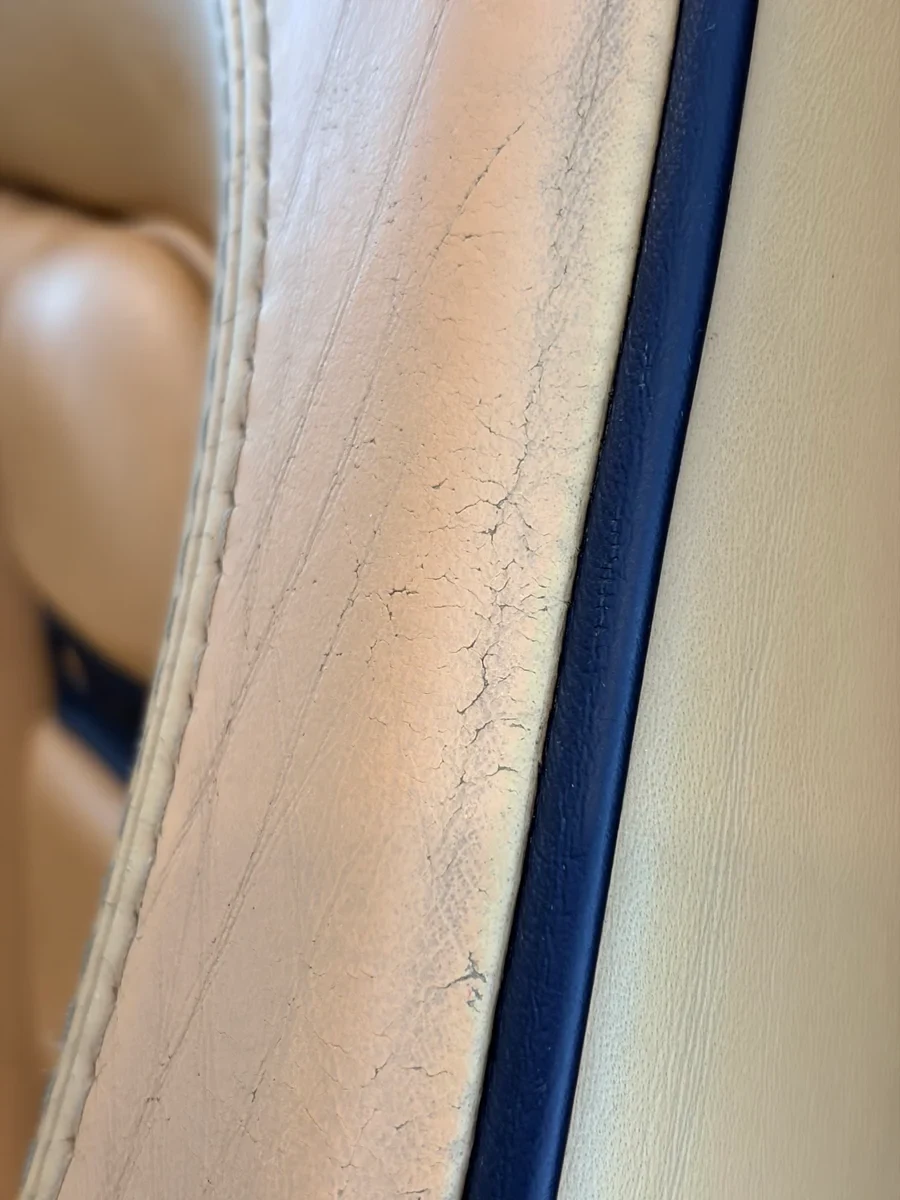
- Recolored sections darker than the surrounding original Cuoio — the replacement color matched a manufacturer chart, not the aged leather in the car
- Visible treatment boundary on both seats, particularly noticeable at the transition between the treated bolster and the untouched seat back
- Paint residue and overspray on the black Daytona inserts, piping, and adjacent trim components
- Surface cracking on the bolsters had not been addressed before the previous color was applied — the cracking was still present beneath the new color
- The corrected sections sat visually disconnected from the rest of the interior — identifiable as a repair, not as the original leather
Why Dealership Touch-Up Repairs Frequently Fail to Match
Pre-delivery cosmetic repairs are performed under time pressure and are rarely the core competency of the facility doing them. Color is typically applied from a pre-mixed stock or from a manufacturer reference without custom blending on the specific vehicle. Ferrari Cuoio presents a particular challenge: the original factory tone is a warm tan-beige with a specific balance of pigment that shifts noticeably with age and UV exposure. A color that reads accurately on new leather looks different on leather that has three to five years of use behind it.
The more fundamental problem is the application method. Touching up only the worn sections without blending into the surrounding leather produces a visible boundary — the difference in finish and color between treated and untreated areas creates a visual step that becomes more apparent as the untouched sections continue to age naturally and the repaired sections age differently under their new finish coat.
Correct restoration work blends into the untouched leather at every edge. The treated and untreated sections should be indistinguishable in natural light. That requires pigment blending on-site against the specific vehicle, application technique that transitions gradually at the boundaries, and sufficient time to do both correctly. None of these conditions are present in a pre-delivery detail environment.
Restoration Process
Deep Leather Cleaning
Both seats were cleaned thoroughly before any assessment began. Effective restoration work cannot start on a contaminated surface — accumulated oils, dust, and residue from the previous refinishing compound need to be removed before the true condition of the leather can be evaluated and before any new product will bond correctly. This step also began to reveal the extent of the color mismatch left by the dealership: with the surface clean, the boundary between the recolored sections and the original leather became unambiguous.
Inspection of Previous Refinishing
After cleaning, each repaired area was inspected closely. The dealership work had been applied to the outer bolsters, lower bolsters, and seat edges — the highest-wear zones on both seats. The previous color was darker than the surrounding Cuoio: a warm tan that had been applied with a color closer to brown or amber, producing a visible mismatch at every transition edge. In certain light conditions the boundary read as a shadow. In direct light it was obvious. Paint residue and overspray had also reached the black Daytona inserts, the black piping, and surrounding trim.
Overspray and Residue Removal
Before any color correction could begin, the overspray on the black inserts, piping, and trim needed to be removed. Removing dried color compound from leather and trim without damaging the surrounding material requires careful solvent application and controlled mechanical work. The black inserts presented the greater challenge — the perforated surfaces of the Daytona pattern hold residue in the stud recesses and along the insert edges. Each area was cleaned individually under inspection.
Surface Preparation and Crack Repair
The bolsters showed surface cracking from the wear they had sustained prior to the dealership's work, and the previous refinishing had been applied over this cracking rather than addressing it first. The cracks were filled with flexible repair compound applied in thin layers. Flexible compound is essential on bolsters and seat edges — these panels flex continuously with every entry, exit, and seating adjustment, and a rigid compound would re-open quickly under normal use. After curing, the filled areas were leveled and prepared for color.
Masking of Every Daytona Insert
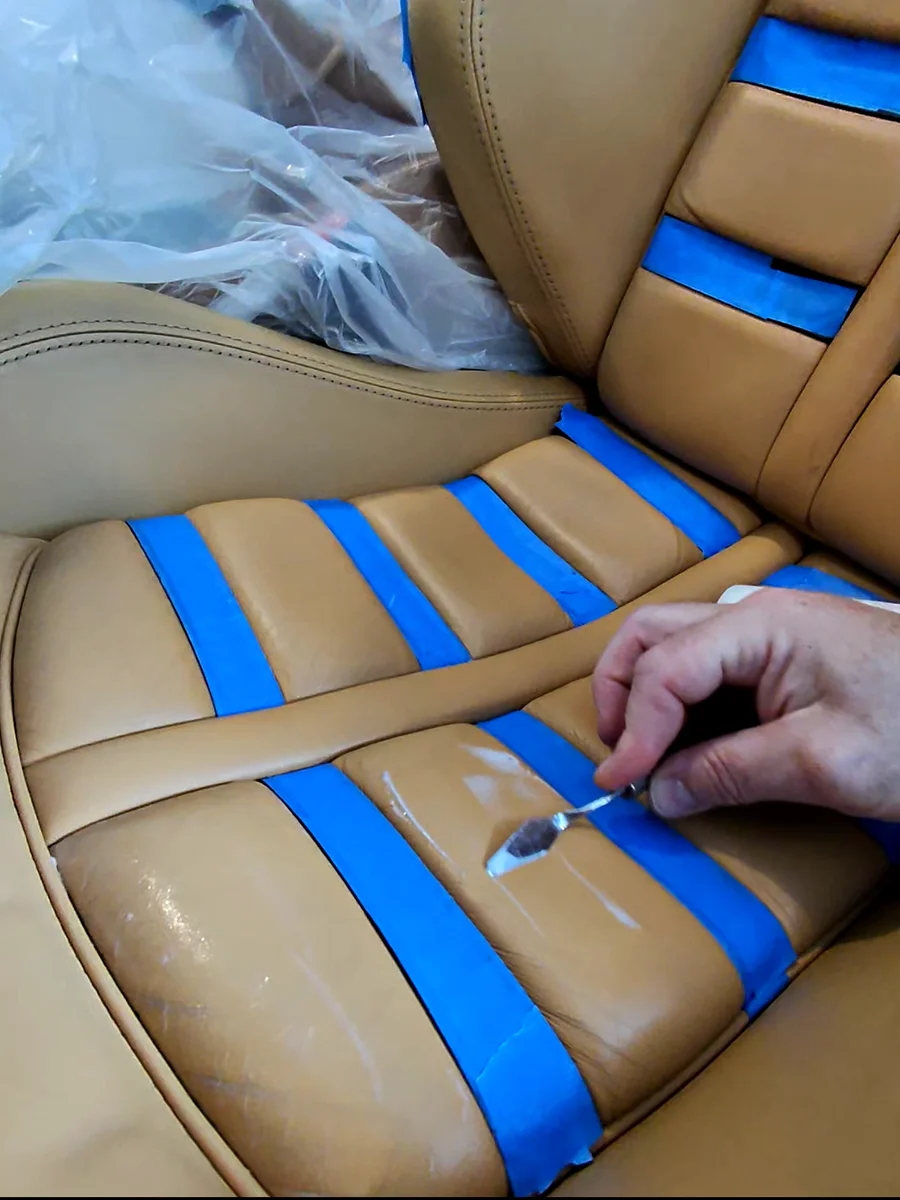
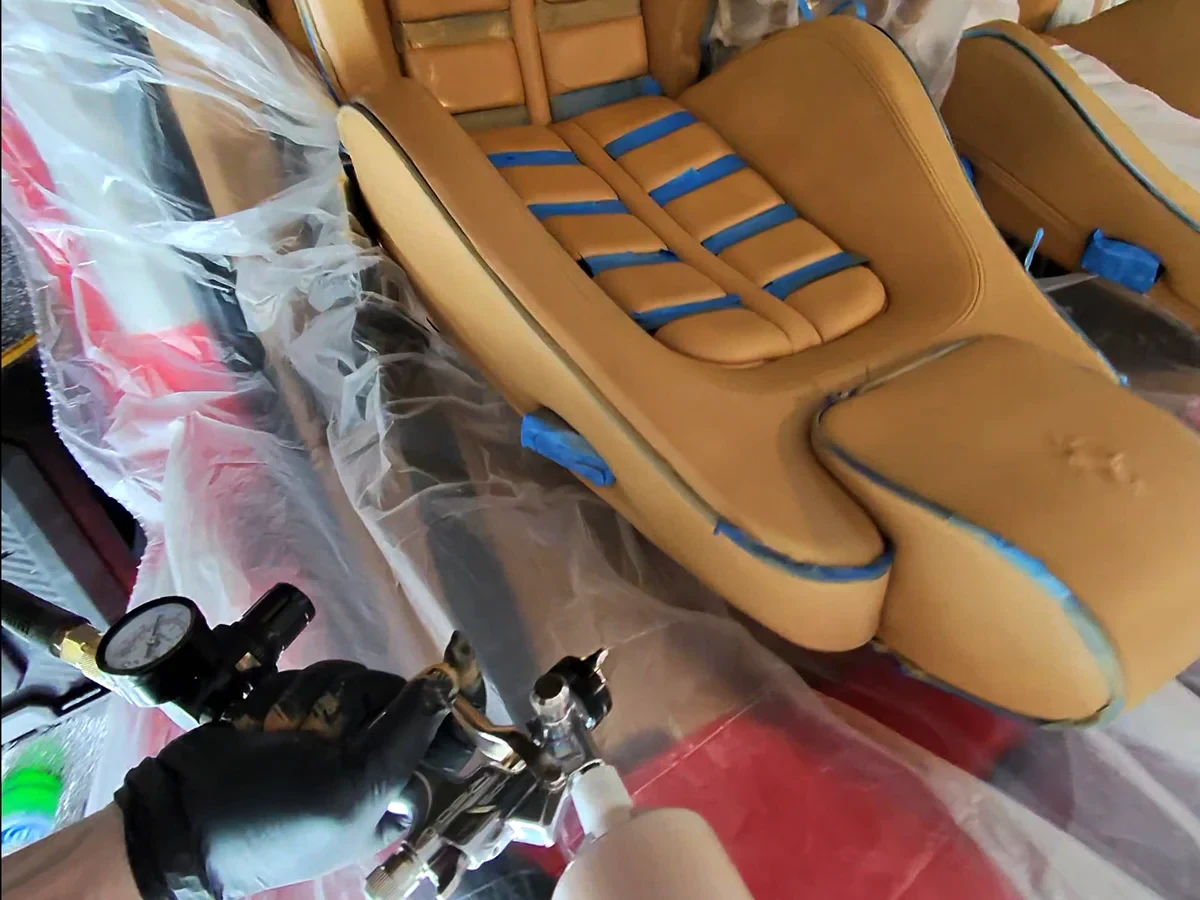
Before any color application to the Cuoio surfaces, every black leather Daytona insert had to be masked individually with tape. The F430 Daytona seat pattern has multiple inserts across both the seat back and the cushion — each one masked along its edges to prevent any Cuoio pigment from landing on the black leather. This is the single most time-consuming part of Daytona seat work, and it cannot be rushed: any overspray onto the black inserts would create a new correction problem. The masking also extended to the black piping, surrounding trim, and components below the seat.
Ferrari Cuoio OEM Color Development
Pigments were blended on-site against the untouched sections of original Cuoio leather — areas that had not been touched by the dealership and retained the correct aged factory color. Ferrari Cuoio is a nuanced tone: the warm tan has a specific balance of yellow, red, and white that is difficult to hit from a color chart. Matching must be done against the actual leather in the actual lighting conditions of the interior. The mix was adjusted incrementally, tested on inconspicuous areas, and confirmed to read identically to the surrounding original leather before application began.
Airbrush Refinishing
The corrected color was applied by airbrush to both seats — the bolsters, lower bolsters, seat edges, and all areas affected by the previous repair. Airbrush application provides the control necessary to blend into the untouched surrounding leather at the transition edges. The goal was a seamless result: no visible boundary between the corrected sections and the original factory leather. Multiple light coats were built up with inspection between each pass to monitor the blend.
Piping Restoration by Hand
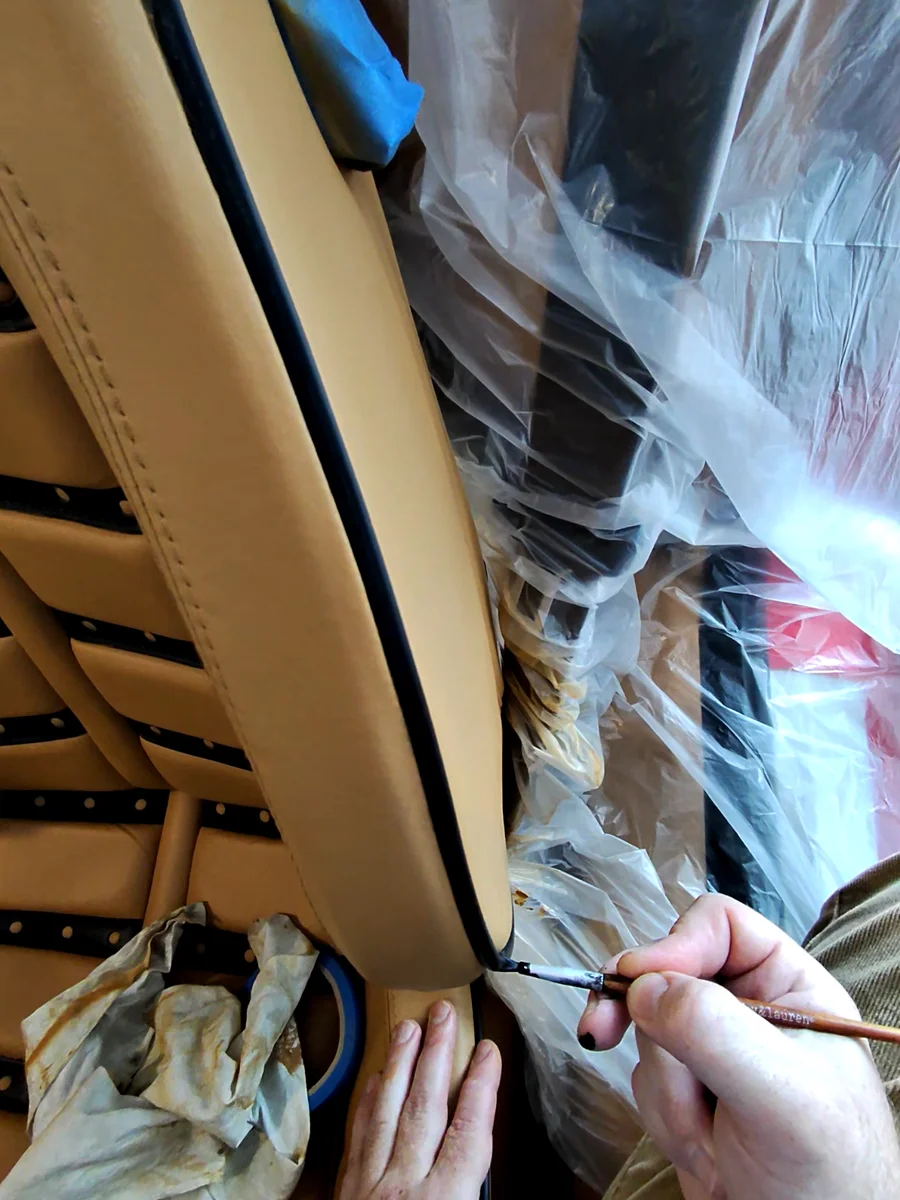
The black piping that runs along the seat edges had been affected by the previous overspray and by surface wear at the seam lines. Piping is too fine and too geometrically constrained to correct by airbrush — the color work was done with a fine artist's brush, applied carefully along each piping run on both seats. This step requires patience: the brush must follow the piping precisely without touching the adjacent Cuoio leather or the black inserts.
UV-Resistant Protective Top Coat
A reinforced UV-resistant top coat formulated for convertible applications was applied to all treated surfaces on both seats. Convertible interiors are exposed to UV radiation directly when the top is down — the protection requirements are higher than for a coupe. The top coat seals the color work, provides UV resistance, restores the appropriate sheen level, and adds a layer of surface durability against the friction the bolsters and seat edges will continue to see in normal use.
Why Daytona Seats Require More Time
Standard Ferrari bucket seats have a relatively straightforward geometry for color work: the main leather surfaces are continuous, the bolsters are defined by seam lines, and the masking required to protect contrast stitching or piping is minimal. Daytona seats are different in every respect that affects restoration time.
Each black leather insert must be masked along all four edges before any Cuoio color is applied. With inserts running across both the seat back and the cushion on both seats, the masking alone adds a substantial portion of total job time before any actual restoration work begins. The tape must be applied precisely — any gap in the masking produces overspray onto the black leather, which creates a new correction problem. Rushed masking turns a Daytona seat restoration into a multi-problem job.
After color application and curing, each piece of masking tape is removed carefully, revealing the clean black inserts beneath. The result should show clean transitions between the Cuoio leather and the black inserts with no visible masking artifacts. On both seats of this F430 Spider, that result was achieved, and the inserts themselves were corrected where the previous dealership overspray had contaminated them.
Why Ferrari Cuoio Color Matching Is Different
Ferrari Cuoio is not a single fixed color — it is a production specification that varies in appearance across model years and leather batches, and it shifts further as the leather ages, receives UV exposure, and accumulates surface wear. Matching it requires working against the specific car, not against a reference standard.
The problem the dealership ran into is a common one: the color they used was probably reasonably close to Ferrari's published Cuoio specification, or to a known-good Cuoio mix, but it did not match the actual leather in the actual car at the time of the repair. On a vehicle with several years of use, the original leather has drifted from its factory reference. A color that matches the chart lands visibly dark or bright against leather that has aged toward something warmer and more muted.
The approach used here was to blend pigments on-site against the untouched sections of original interior — the areas the dealership had not touched and that retained the correct aged Cuoio tone. The mix was tested on inconspicuous areas and adjusted until it was optically indistinguishable from the surrounding leather before any application to the corrected areas began. The result is a repair that reads as the original material, not as a corrected section sitting next to it.
The Result
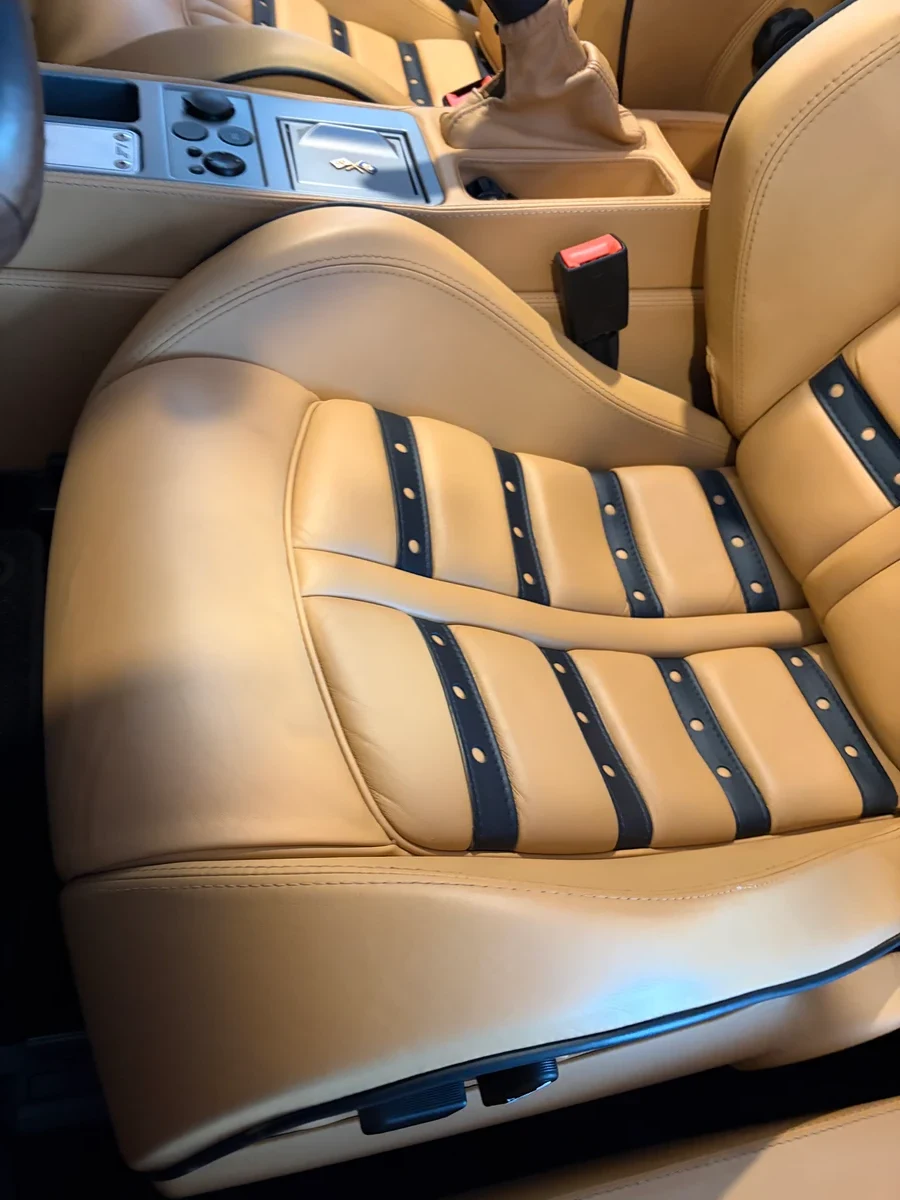
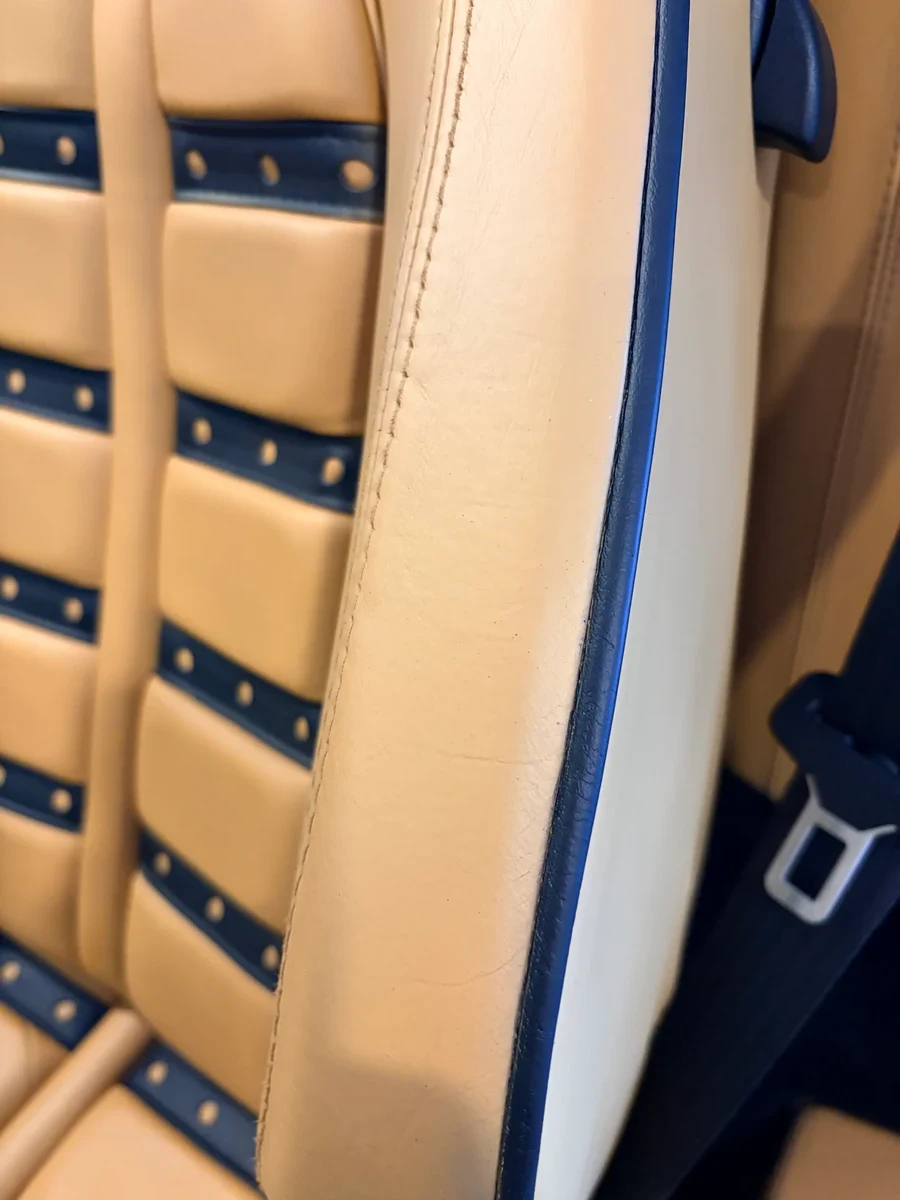
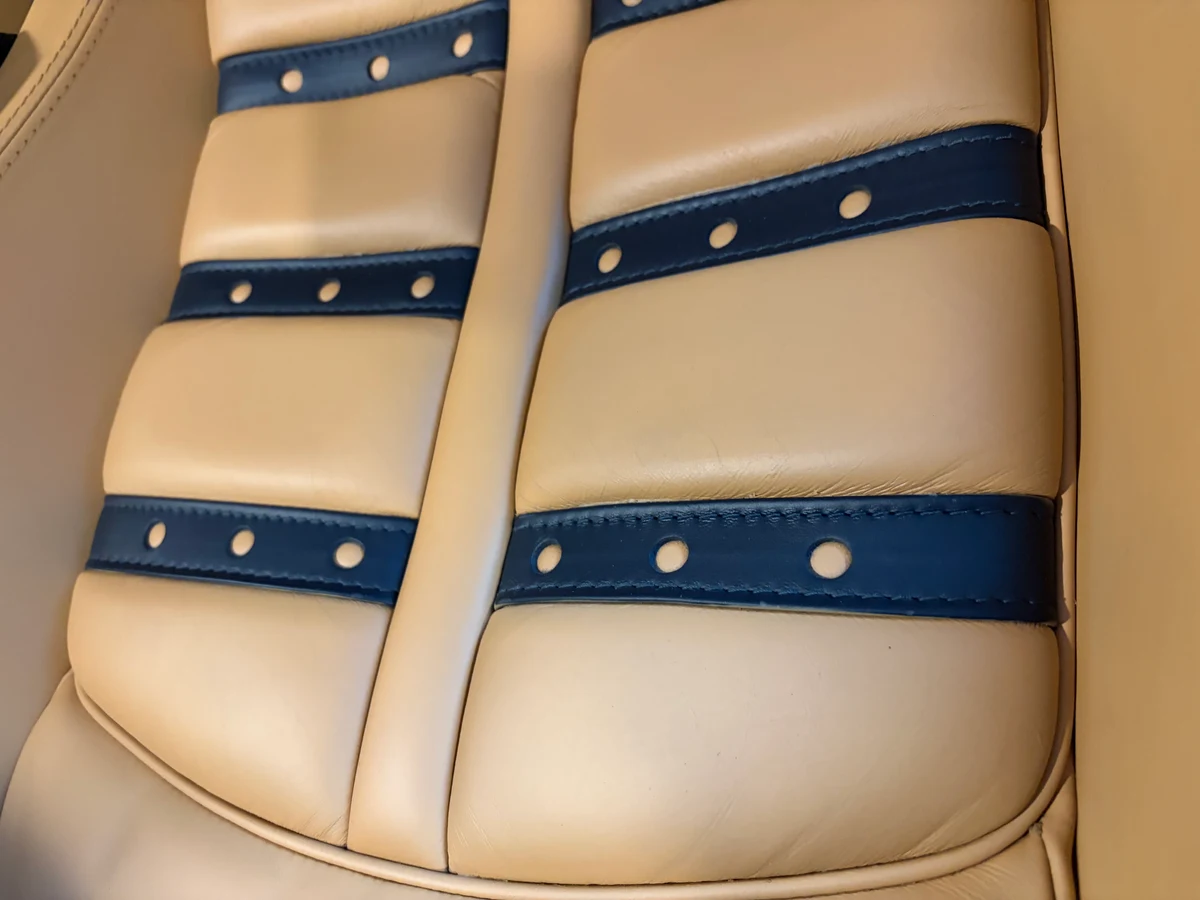
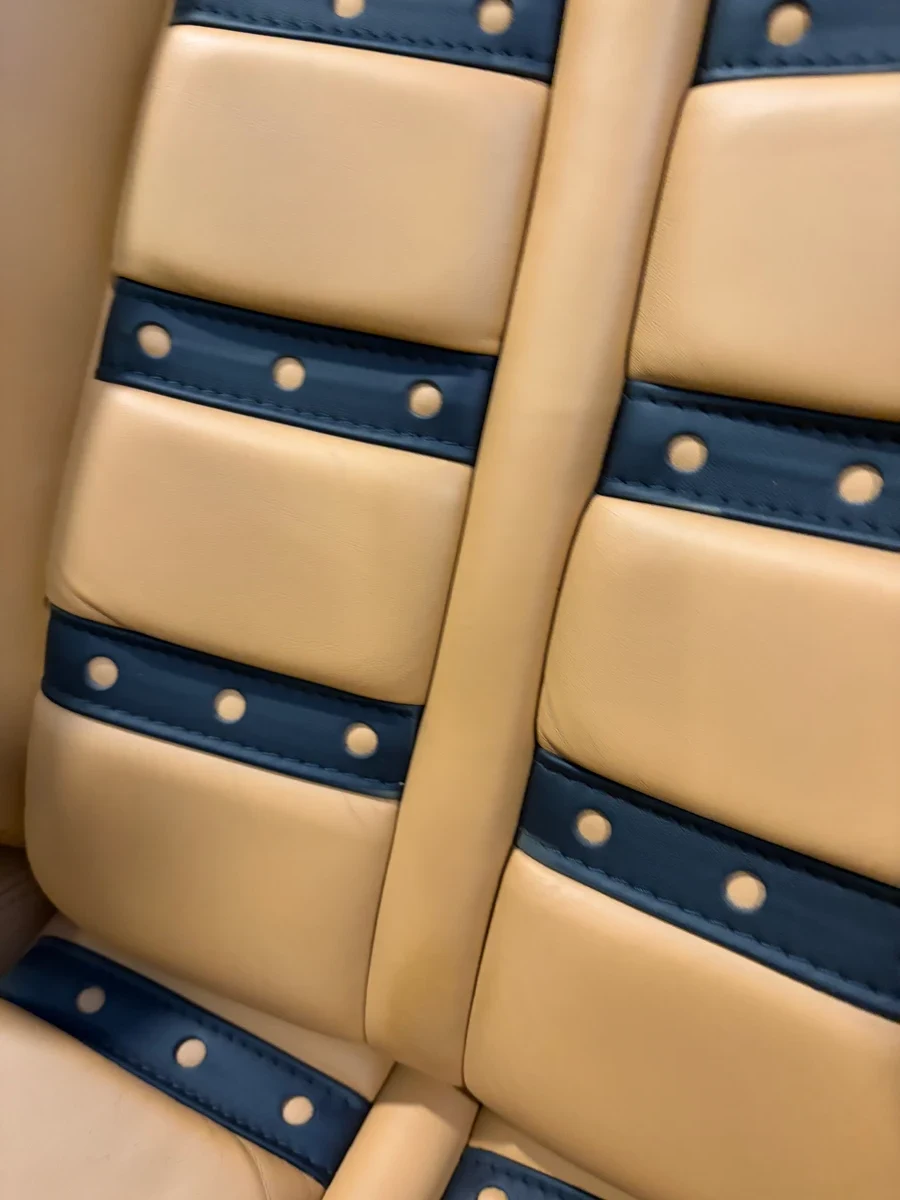
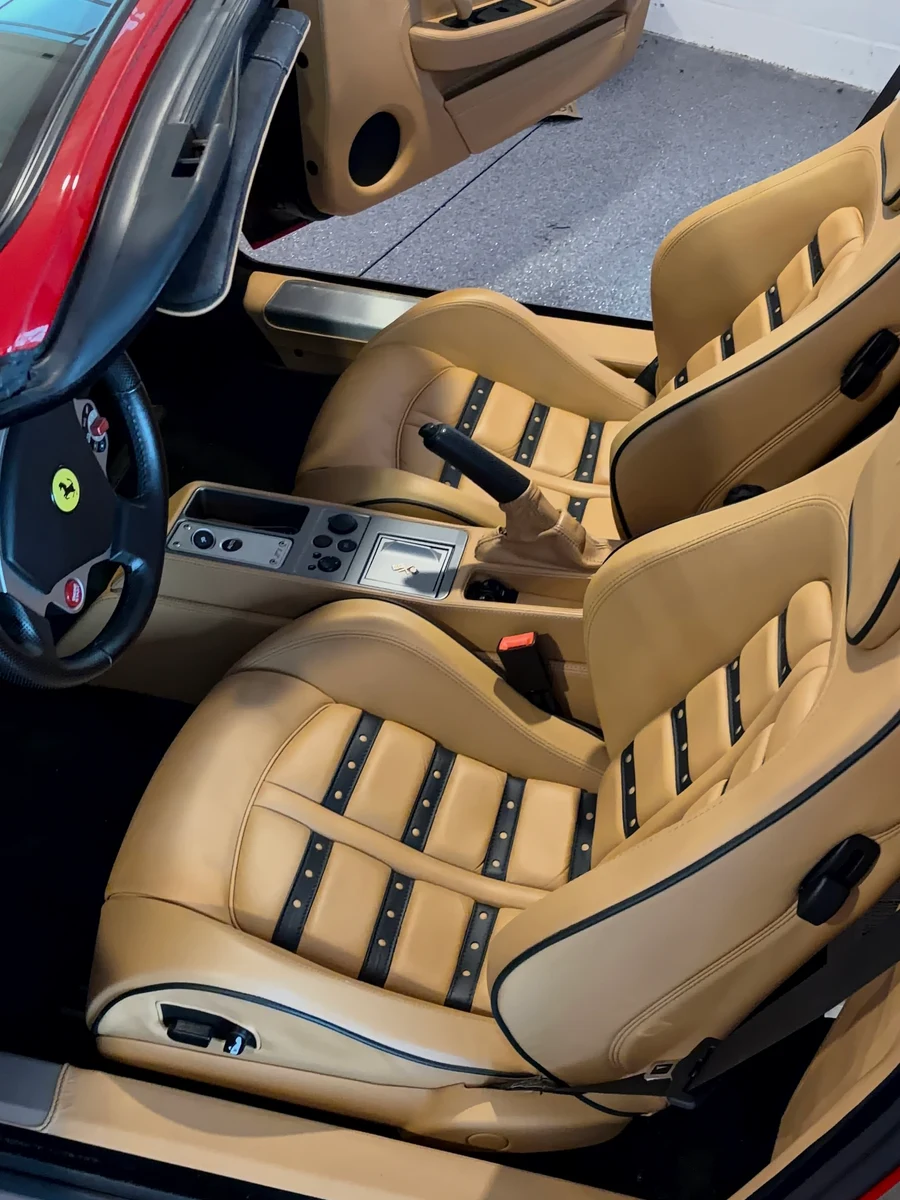
- Dealership color mismatch fully corrected — both seats read as a single, consistent Cuoio interior
- Bolster cracking filled, leveled, and refinished — no visible evidence of previous surface damage
- Paint residue and overspray removed from all black Daytona inserts, piping, and surrounding trim
- Black piping restored by hand along all seat edges — clean lines throughout
- Custom Cuoio color developed on-site against the original untouched leather sections
- UV-resistant convertible top coat applied to all treated surfaces on both seats
- No original Ferrari leather replaced — corrective restoration only
- Interior reads as OEM factory condition in normal use and natural light
Convertible-Specific Considerations
A Spider that is driven regularly with the top down requires a different approach to top coat protection than a coupe in comparable condition. Coupe interiors see filtered UV through glass, stable interior air, and consistent temperature. A convertible interior, when the top is down, is in direct sunlight, exposed to moving air carrying dust and particulate, and subject to wide swings in temperature as the car heats and cools through a drive.
The top coat applied to this F430 Spider interior uses a formulation specifically developed for convertible applications — higher UV resistance, higher flexibility to accommodate the expansion and contraction cycles the leather will experience, and sufficient durability to hold up against the environmental exposure a car used as intended will encounter. Applying a standard protective finish to a convertible interior and expecting equivalent performance is an incorrect assumption.
Preserving the Original Ferrari Leather
The owner's brief was specific: correct the dealership's work and restore the original appearance, without replacing any leather. This is the correct brief for a car in this condition. The leather substrate throughout both seats was structurally sound — no delamination, no tears, no stitching failure. The issues were entirely at the finish and color layer. Replacement would have discarded structurally intact Italian leather in favor of new material that would need to be matched in grain and color, and would alter the originality of the interior.
Replacing the front seat leather on an F430 Spider with Daytona seats is also not a straightforward exercise. The Daytona seat construction — with its individual inserts, contrast piping, and specific Cuoio specification — requires sourcing materials that match both the leather character and the structural details of the original seats. The cost is significant, and the result is a car with replacement leather rather than its original interior.
Restoration leaves the car with its original material — corrected and protected, but fundamentally intact. For an enthusiast who intends to use and keep the car, that outcome is worth considerably more than a replacement that costs more and compromises provenance.
Related Services
- Luxury Auto Leather Repair → Ferrari, Porsche, Bentley, Rolls-Royce, and exotic vehicle interiors
- Auto Interior Restoration → mobile leather restoration for all vehicle makes across NYC and New Jersey
- Leather Color Restoration → OEM color matching and corrective refinishing for automotive and furniture leather
Mobile Ferrari Leather Restoration — NYC & New Jersey
Leather & Vinyl Care provides mobile leather restoration for Ferrari and other exotic vehicles throughout Brooklyn, Manhattan, Queens, Long Island, and New Jersey. We come to your garage — no transport, no shop drop-off.
Frequently Asked Questions
Why do dealership leather repairs often fail to match the original Ferrari interior?
Dealership touch-up repairs are typically performed quickly, often using generic pre-mixed colors rather than custom-blended pigments matched to the specific vehicle. Ferrari Cuoio in particular shifts with age — a color that was accurate on delivery reads differently on leather that has two or three years of UV exposure and normal use. Matching Cuoio correctly requires blending on-site against the untouched original leather, not against a manufacturer color chart. When the matched color is also applied only to the worn sections rather than blended into the surrounding area, the boundary between treated and untreated leather becomes visible, particularly in natural light.
What are Ferrari Daytona seats and why are they significant?
Ferrari Daytona seats take their name from Ferrari's 1-2-3 podium finish at the 1967 Daytona 24 Hours. The seat design features a distinctive pattern of horizontal leather straps or inserts — typically in a contrasting color — running across both the seat back and cushion, with individual studs at each intersection. In the Ferrari F430, Daytona seats were an available option rather than standard equipment, making them significantly less common than the base F430 interior. Restoration of Daytona seats is more labor-intensive than standard bucket seat work because each individual insert must be masked separately before any color work can begin.
How do you match Ferrari Cuoio leather color accurately?
Ferrari Cuoio is a warm tan-beige tone that varies in appearance depending on production year, leather batch, and how the hide has aged. Matching it accurately requires mixing pigments on-site and testing directly against untouched sections of the original leather — ideally in the areas that have seen the least UV and friction exposure. Color charts and manufacturer references are a starting point, not a match. The mix is adjusted incrementally until it is indistinguishable from the surrounding material before any application to the repaired areas begins. On a corrective restoration like the F430 Spider, the goal is for the corrected sections to read identically to the untouched factory leather — not to a factory color chip.
Why do convertible car interiors require stronger UV protection than coupe interiors?
A convertible interior is exposed to direct UV radiation, wind, ambient dust, and moisture cycling every time the top is lowered — and many owners drive with the top down regularly. A coupe interior sees filtered light through glass, minimal air exposure, and stable interior humidity. The result is that leather in convertible interiors typically degrades faster without proper protection: the surface finish breaks down earlier, color fades more quickly, and the leather loses moisture at a higher rate. A UV-resistant top coat specifically formulated for convertible interiors applies a higher-durability protection layer that accounts for this elevated exposure. It is not optional on a car that is driven with the top down.
Is it possible to restore Ferrari leather without replacing the original panels?
Yes, in most cases involving cosmetic deterioration — color loss, surface cracking, finish failure, or incorrect previous refinishing. Replacement becomes necessary when the leather substrate itself has failed: deep structural tears, delamination from the backing, or stitching failure that cannot be repaired from the surface. The leather on this F430 Spider retained its structural integrity throughout. The issues were entirely at the surface and finish level. Restoration preserved the original Ferrari leather, the factory Daytona seat construction, and the integrity of the interior as it left Maranello.
Do you provide mobile Ferrari leather restoration in New Jersey?
Yes. Leather & Vinyl Care provides mobile leather restoration for Ferrari and other exotic vehicles throughout New Jersey and the greater NYC metro area. We come to your location — private garage, residence, or storage facility — with all equipment, pigments, and materials. The vehicle does not need to be transported. This project was completed on-site in New Jersey.
Related Reading
- Preserving the Original Leather in a 2013 Mercedes-Benz SLS AMG GT Roadster →
- 2018 Lamborghini Huracán Steering Wheel and Leather Interior Refinement →
- Ferrari F355 Berlinetta Leather Interior Preservation for Show Preparation →
- Ferrari 360 Modena Interior Leather Restoration — Long Branch, NJ →
- Ferrari 599 GTB Fiorano Interior Leather Restoration in NYC →
- Porsche 993 Carrera S Interior Leather Restoration — New Jersey →
- Porsche 911 Targa 4 Leather Seat Restoration in New Jersey →
- How Much Does Leather Repair Cost in NYC? (2026 Price Guide) →