Case Study · Furniture Restoration · October 2025
Luxury Leather Furniture Color Matching & Restoration in New York
A leather sofa and two matching club chairs, UV-damaged and showing near-total finish failure, were professionally cleaned, crack-repaired, and restored to a custom color developed to coordinate with leather dining seating within the same residence — while preserving the original white contrast piping throughout.
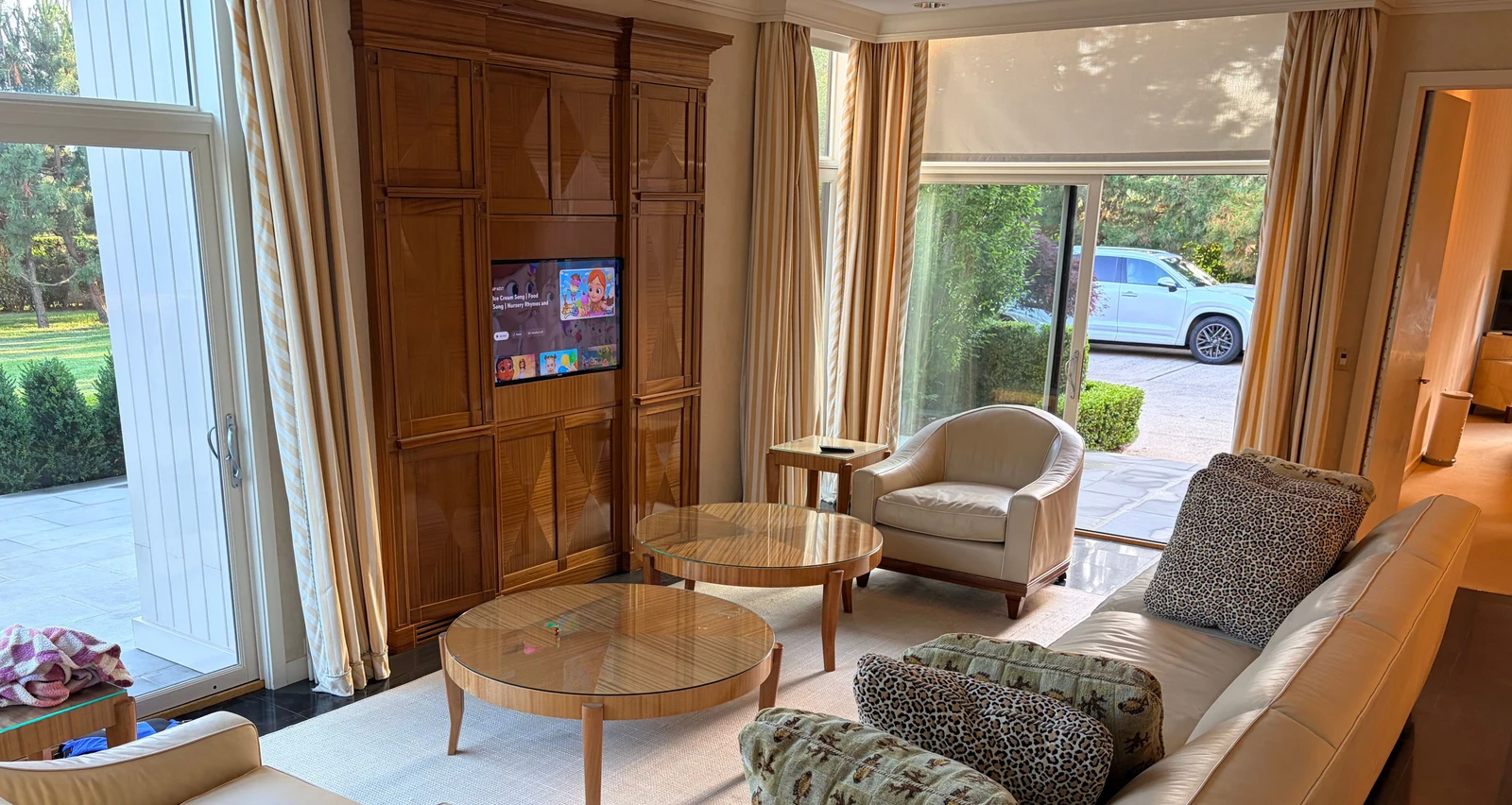
The restored collection in the New York residence — sofa and two club chairs unified in the custom color developed for this project
A luxury leather furniture collection — a large sofa and two matching barrel-back club chairs — presented the kind of condition that accumulates quietly over years of sustained UV exposure and incorrect care. The pieces had sat opposite floor-to-ceiling windows; prolonged UV had faded and dried the cream leather across every surface. Commercially available conditioning products applied by the owner had left a waxy, sealing residue that prevented the leather from breathing and accelerated the dehydration beneath. The visible result was heavy soiling embedded in the grain, near-complete finish failure across the seating surfaces, and a network of surface cracks that had spread as the hide dried and contracted.
The client's brief was clear: restore the original leather — not replace it. The furniture also needed to coordinate with leather dining chairs elsewhere in the same residence, which meant developing a custom color rather than simply restoring the original warm cream. Preserving the original white contrast piping that frames every cushion and panel on all three pieces was the third constraint that defined the scope.
The work involved professional deep cleaning, surface preparation, crack filling, custom pigment development, full leather color restoration, and a protective top coat — completed across all three pieces to produce a cohesive, harmonized result.
At a glance: Professional restoration of a luxury leather sofa and two matching club chairs in New York. The collection presented severe UV fading, surface cracking, finish failure, and heavy soiling. Work included deep cleaning, surface preparation, flexible crack filling, custom leather color matching, full recoloring across all three pieces, and a protective top coat — with the original white contrast piping preserved throughout using precision masking. The custom color was developed specifically to coordinate the furniture with leather dining seating elsewhere in the same residence. All original leather preserved; no leather replaced.
Project Overview
Location
New York
Date
October 2025
Furniture
Large leather sofa, two leather club chairs
Original Leather
Cream leather with white contrast piping
Primary Issues
UV fading, finish failure, surface cracking, color loss
Work Type
Full restoration — cleaning, crack repair, custom color, recolor, top coat
Key Challenge
Custom color to coordinate with dining seating; piping preservation
Approach
Full preservation of original leather throughout
Original Condition
All three pieces showed consistent damage: the original cream leather had faded unevenly, taking on a dull, gray-tinged quality across the seating surfaces and backs. The finish layer had deteriorated significantly — when viewed at close range, the leather surface on the seat cushions showed a fine network of cracks that had spread across the material as the underlying hide dried out and contracted. In the most-used areas, the cracking had deepened and the surface had begun to pit.
Heavy embedded dirt had accumulated in the grain and along the piping channels — environmental grime compounded by the residue of inappropriate conditioning products applied over the years.
The white contrast piping, which runs continuously along every panel seam and cushion edge, remained structurally intact — a fortunate finding, as replacing piping requires either sourcing matching leather cord or reupholstering the panels entirely.
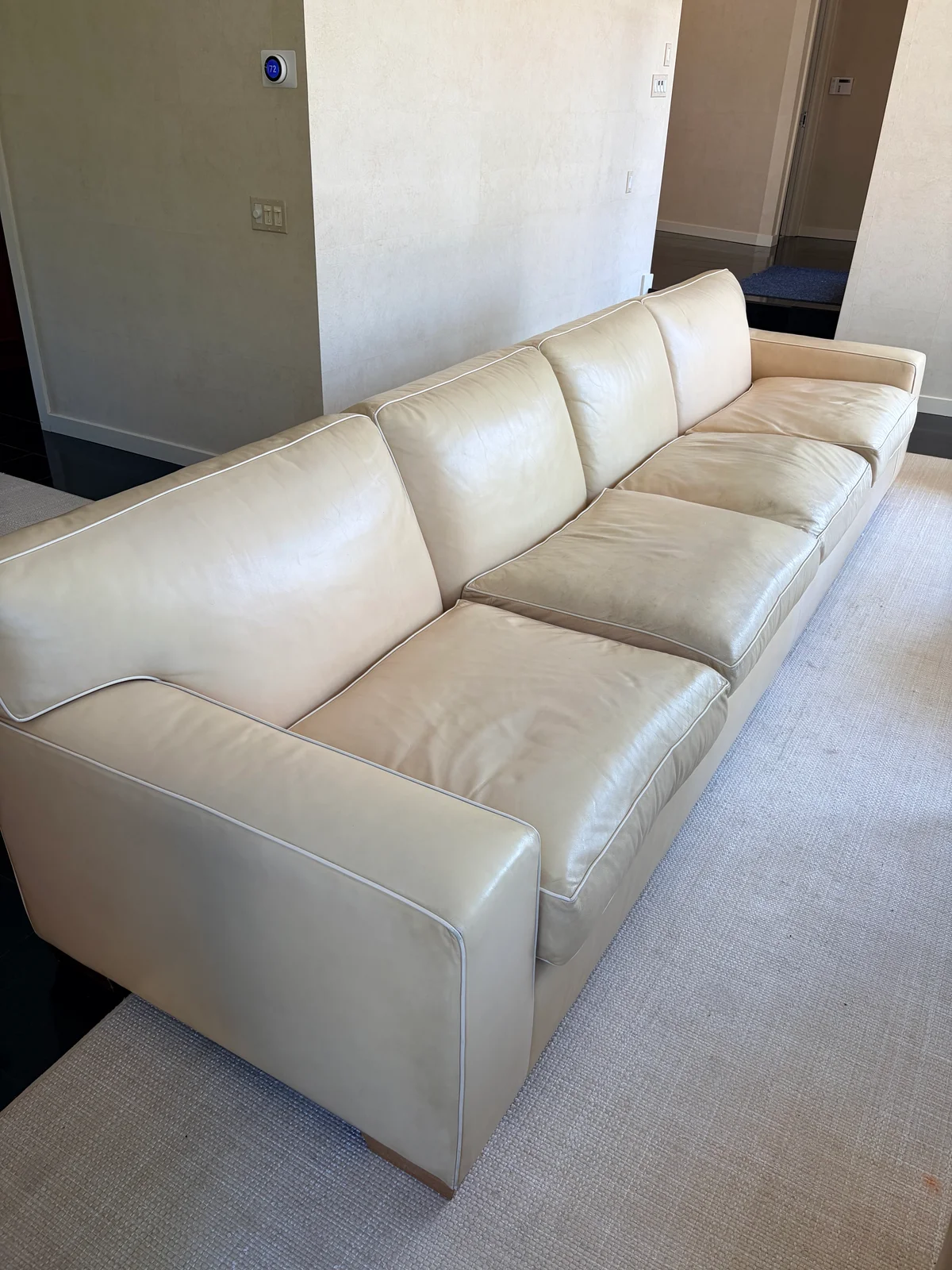
Large leather sofa — UV fading visible across all cushion surfaces
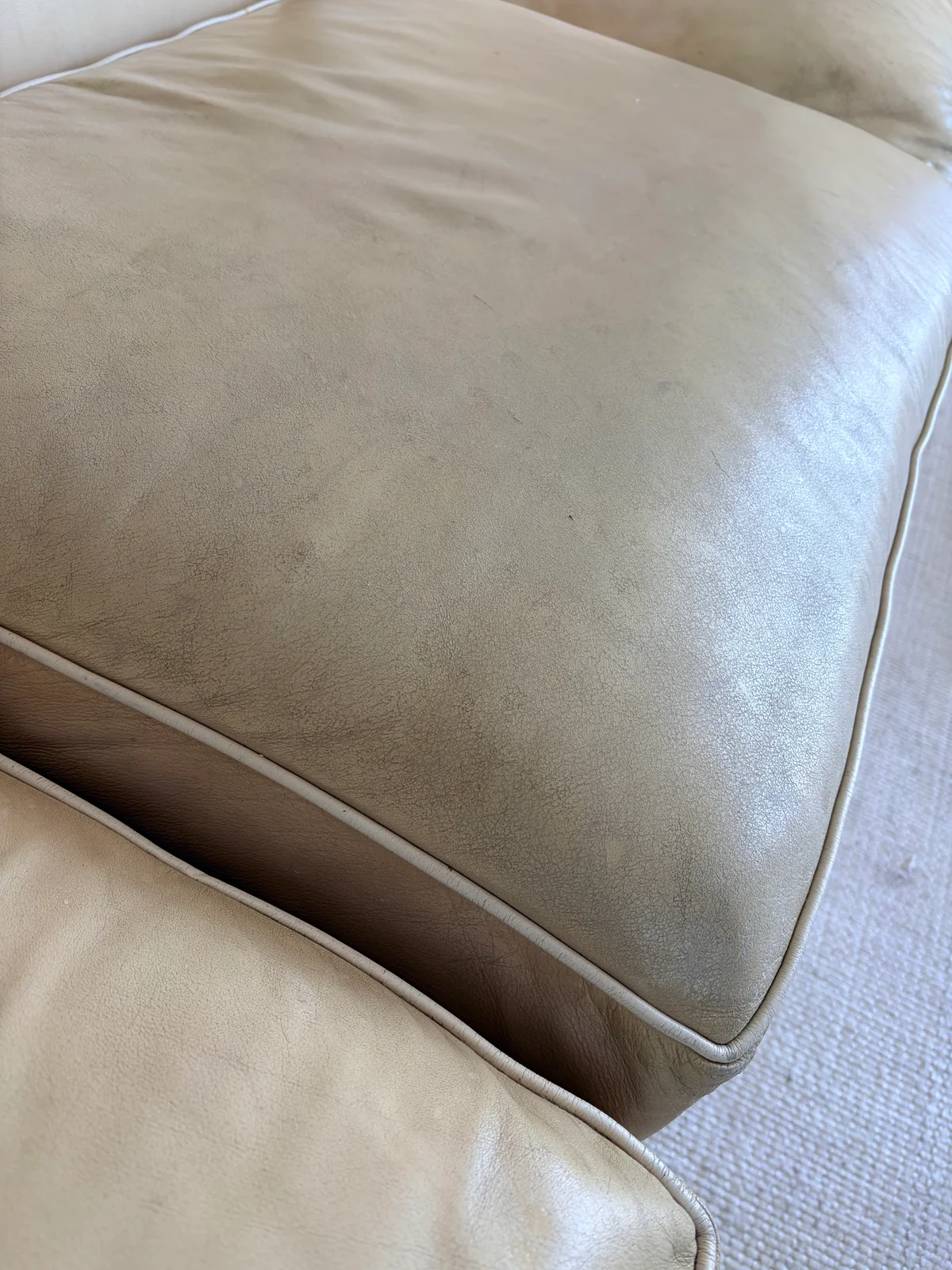
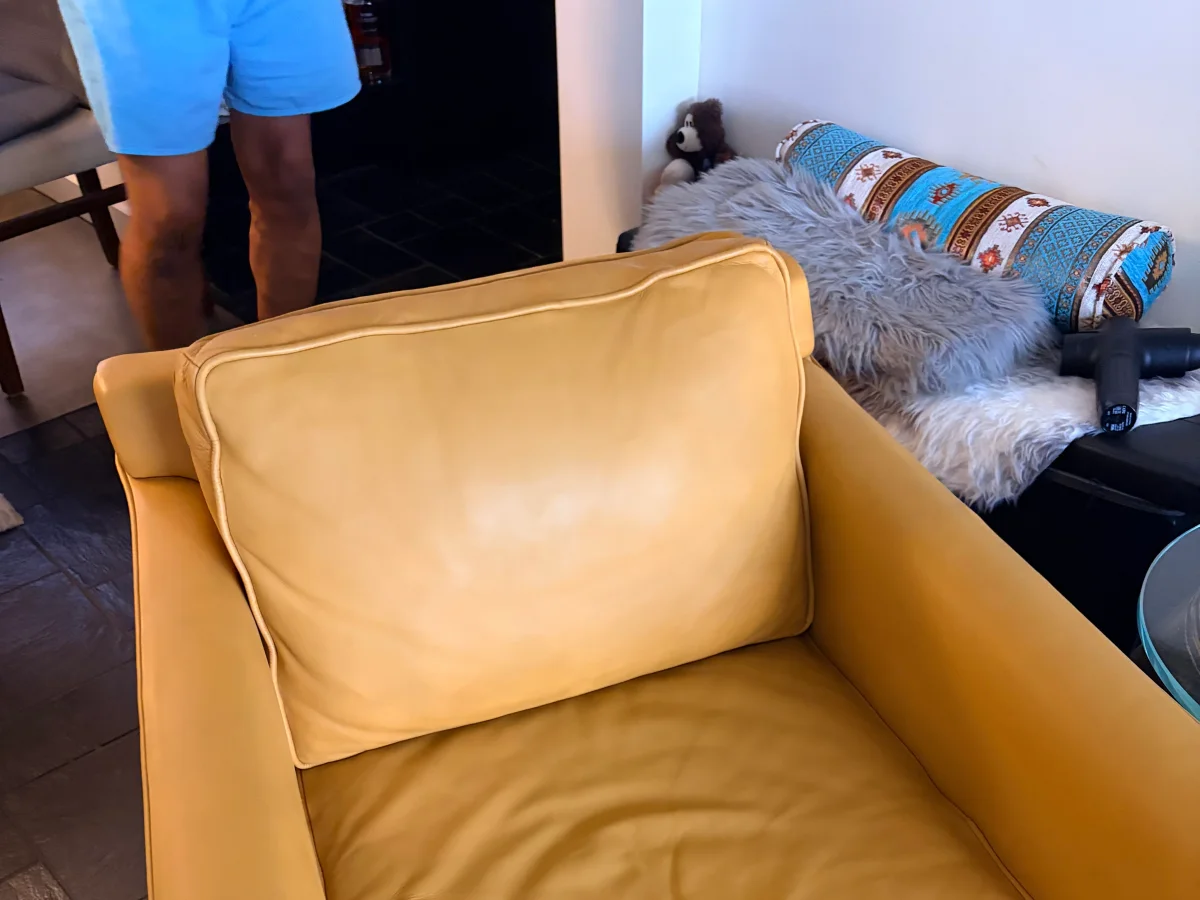
Cushion close-up — color fading, embedded dirt, and finish loss across the leather surface
Restoring UV-Damaged Leather Furniture
UV light degrades leather through two mechanisms that accelerate each other. First, it breaks down the dye molecules in the finish, causing the color to shift, bleach, or fade unevenly depending on which areas receive the most direct or indirect light. Second — and more critically — UV radiation drives moisture out of the leather, causing the hide to contract, stiffen, and eventually crack as the surface loses its flexibility.
Improper care products compound this process. Silicone-based conditioners and non-leather-specific polishes coat the surface with a residue that prevents moisture from re-entering the leather, effectively sealing in the dehydration. The leather beneath may appear glossy and maintained while actually continuing to deteriorate.
The result visible on this sofa — an intricate network of fine surface cracks spread across the seat and back surfaces — is the end state of this combined process: a leather finish that has dried, contracted, and fractured. At this stage, the leather requires professional intervention. Conditioning alone cannot restore finish that has already failed.
On this project, restoring the UV-damaged leather furniture required the full sequence: deep cleaning to strip the waxy residue barrier, surface preparation to open the compromised finish, crack filling in successive layers to level the cushion surfaces, and complete recoloring with a custom-developed pigment. Sun-faded leather sofa restoration at this stage of deterioration requires each step in order — none produces a durable result on its own. The original leather substrate, structurally sound throughout, was preserved.
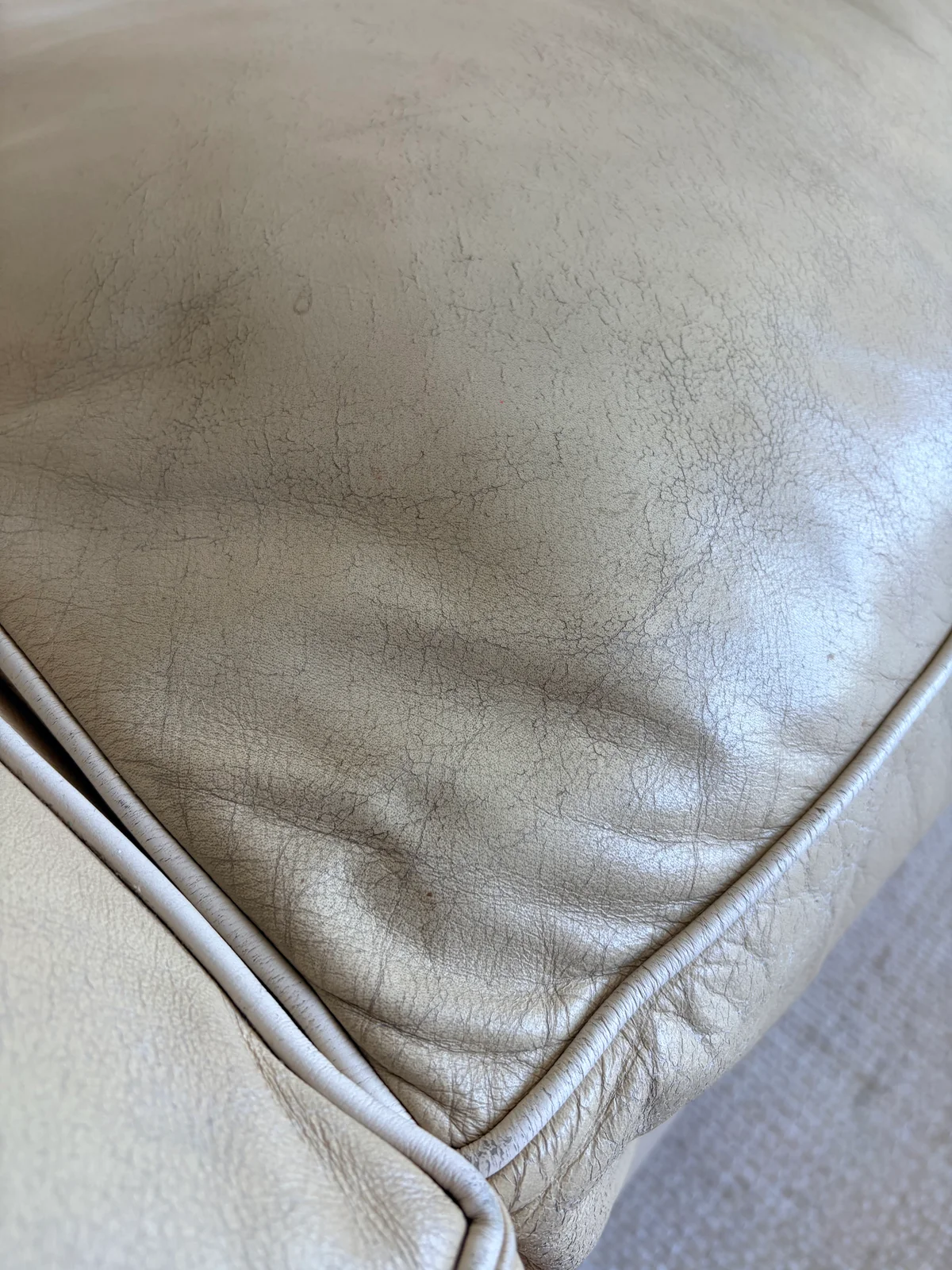
Finish failure at cushion corner — extensive crack network from UV exposure and dehydration
The Restoration Process
Deep Leather Cleaning
Professional-grade leather cleaners were used to remove years of embedded grime and residue from improper care products. Each piece was cleaned in sections, with particular attention to the seam channels and piping edges where contamination accumulates.
Surface Preparation
Once cleaned, the leather was prepared for restoration using a deglazer to open the surface and remove the compromised finish layer. This step is essential for adhesion — new color applied over an intact but failing finish will not bond correctly.
Crack Filling and Leveling
The network of surface cracks across the seat and back cushions was addressed using a flexible leather filler applied in successive thin layers. Each layer was worked into the crack with a palette knife, then allowed to cure before the surface was smoothed. Heavy cracking required multiple applications to achieve an even, level result.
Custom Color Development
The client specified a color that would coordinate the furniture collection with leather dining seating elsewhere in the residence. A custom pigment blend was developed to meet this requirement — a refined, slightly cooler tone than the original warm cream, designed to harmonize across the full interior. The blend was tested on both the sofa and a chair before application to ensure consistency across different pieces.
Piping Protection and Color Application
Before any color was applied, the white contrast piping on every cushion and panel of all three pieces was masked with professional tape. Color was applied by spray in thin, even passes, building coverage gradually to avoid pooling at panel edges. Each piece received multiple coats.
Protective Top Coat
A flexible protective top coat was applied across all surfaces, sealed at the appropriate sheen level to match the original finish character of the leather. The top coat provides UV resistance and surface durability, protecting the color and extending the life of the restoration.
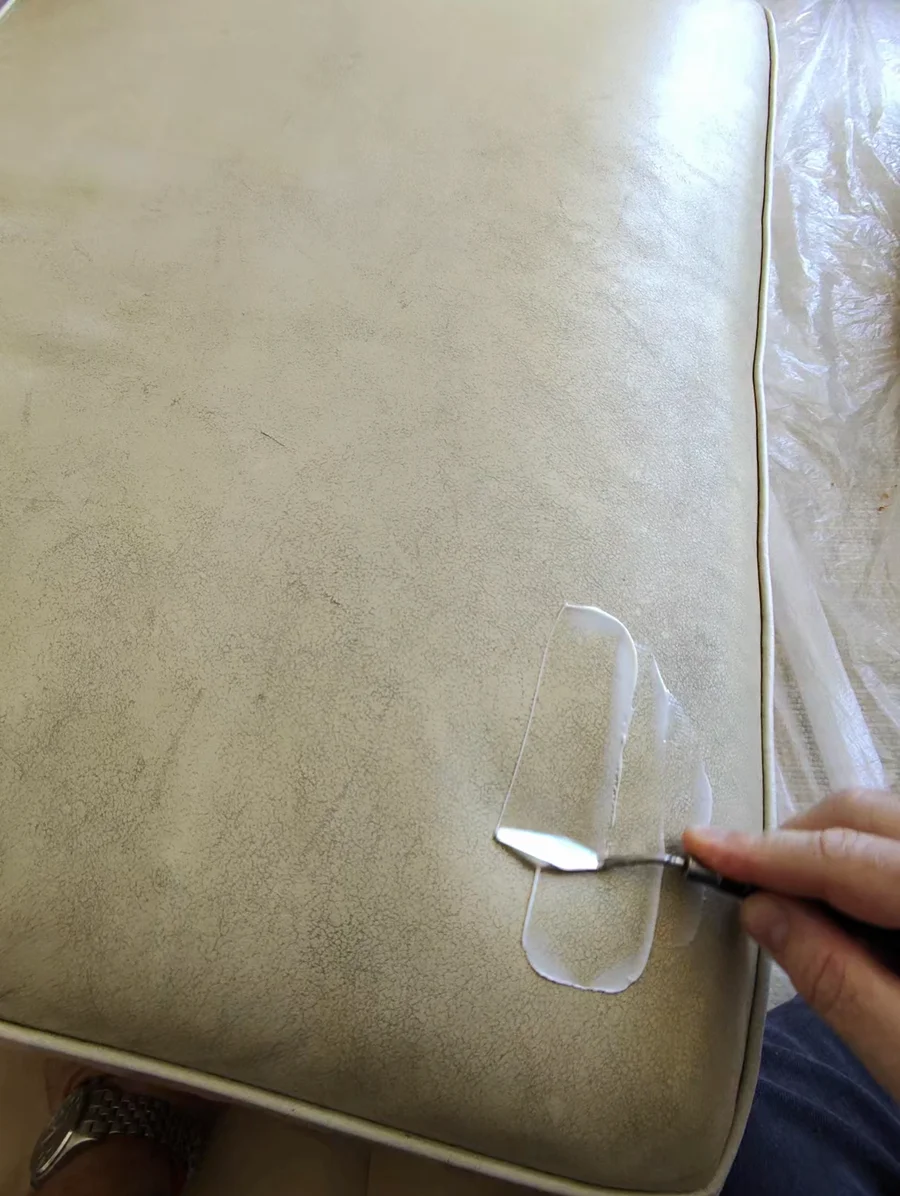
Flexible leather filler applied in thin layers to restore the cushion surface before color is introduced
Custom Color Matching Across the Furniture Collection
The client's requirement was precise: the sofa and chairs needed to read as part of a unified interior that included a set of leather dining chairs in an adjacent area of the residence. The original warm cream of the furniture, even after restoration, would not achieve this — the dining seating called for a different, more coordinated tone across the full leather palette of the space. Maintaining color consistency across the full leather presence of the room was as important as the restoration itself.
This is custom leather color matching in the precise sense — a service distinct from standard leather color restoration. In conventional restoration, the goal is to match the existing leather as closely as possible — to make the repair disappear. Here, the goal was to develop a new color intentionally — one that preserved the character of the original leather while shifting its tone to harmonize with the broader interior.
The blend developed for this project produced a refined, slightly cooler quality compared to the original warm cream — retaining the furniture's lightness and elegance while creating the visual coherence the client needed. The blend was tested on a neutral area of the sofa and one chair, reviewed alongside reference material from the dining area, and refined before application began.
Developing a single color blend and applying it consistently across three pieces — each of which had aged and faded at different rates depending on placement in the room — required careful monitoring during application. The coverage was built up in thin passes rather than single heavy coats, which allowed better control over how the color integrated with each piece's individual surface character.
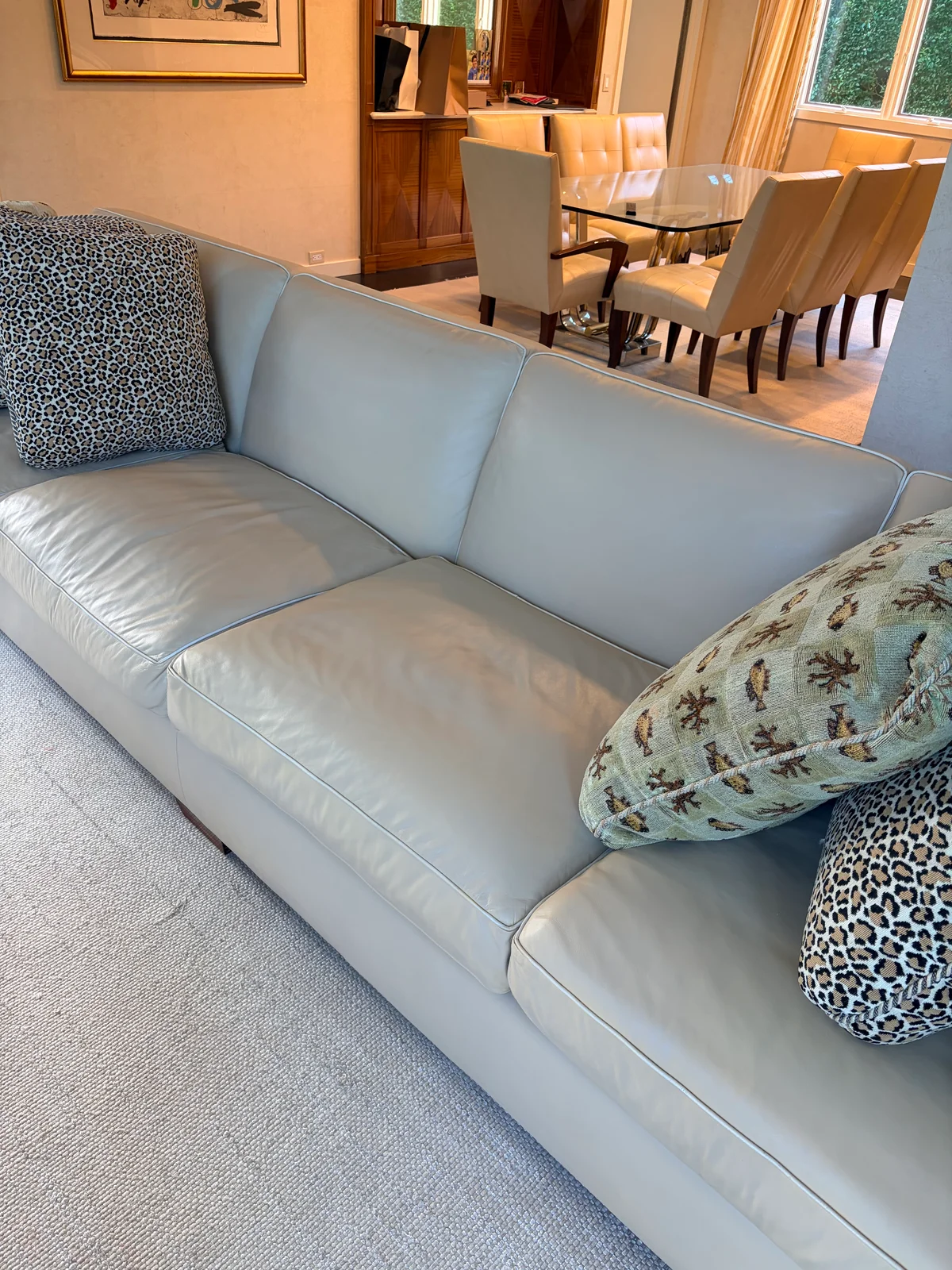
The restored sofa in context — the custom color harmonizes the furniture with the broader interior, including the dining area visible in the background
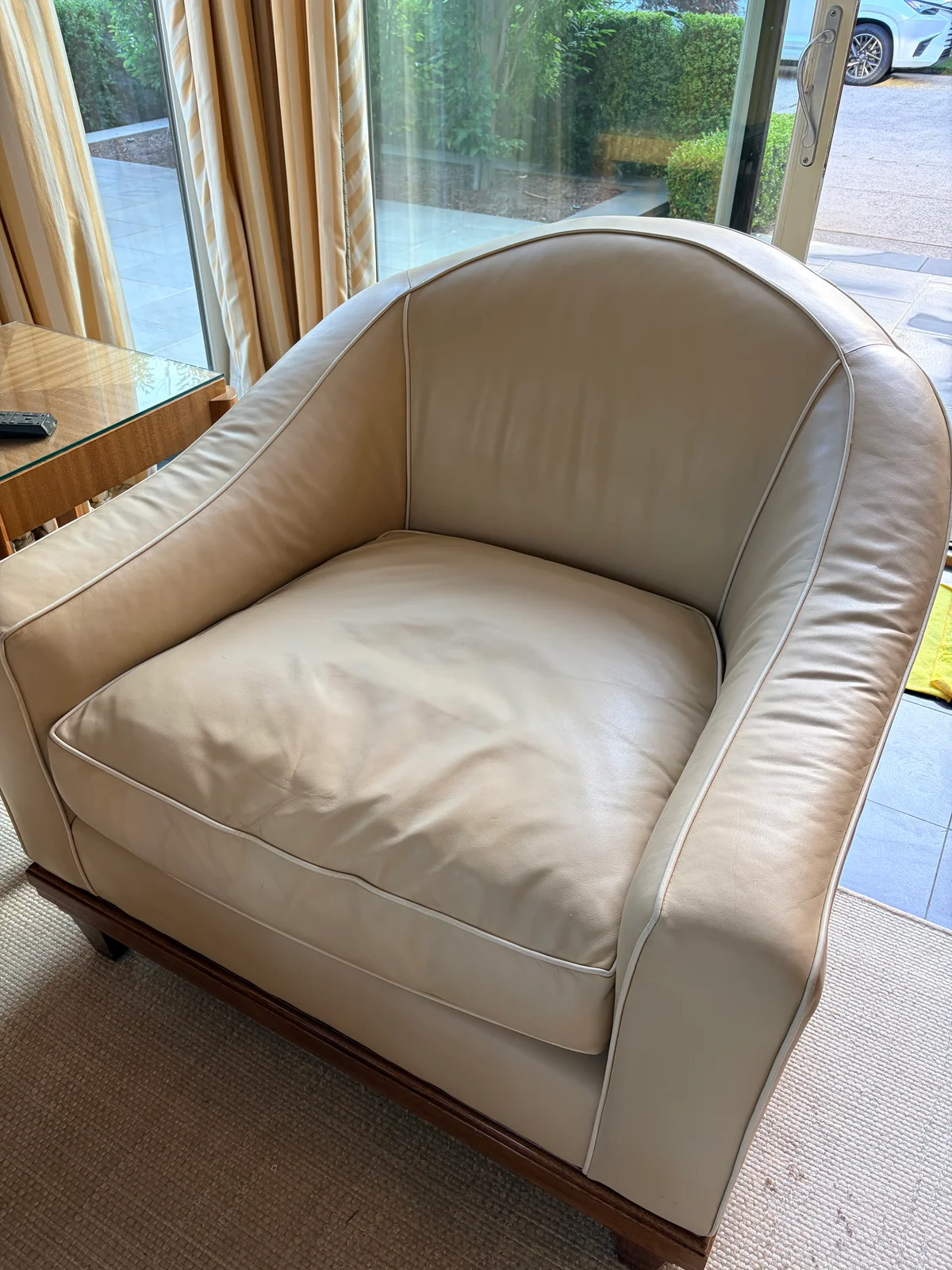
One of two matching club chairs — custom color applied, original white contrast piping preserved throughout
Preserving the Original White Contrast Piping
The white contrast piping is the defining design element of this furniture collection — a continuous trim of cream-white leather cord that runs along every panel seam and cushion edge on the sofa and both chairs. Preserving it was non-negotiable: piping replacement would require panel removal and significantly more complex reupholstery work, and a close color match to original white piping leather is rarely straightforward.
Before any color was applied, every run of piping on every piece was masked with professional tape, laid precisely along the edge where the piping meets the main leather panel. This masking was applied cushion by cushion, panel by panel — a time-intensive step that is bypassed at significant risk in production-oriented shops.
Color was then applied by spray in controlled passes, with the masked piping acting as a physical boundary. After each color coat dried, the masking was inspected and re-seated as needed before the next pass. The protective top coat was applied the same way.
The result: the white contrast piping reads as intended — clean, defined, and visually sharp against the restored leather surface.
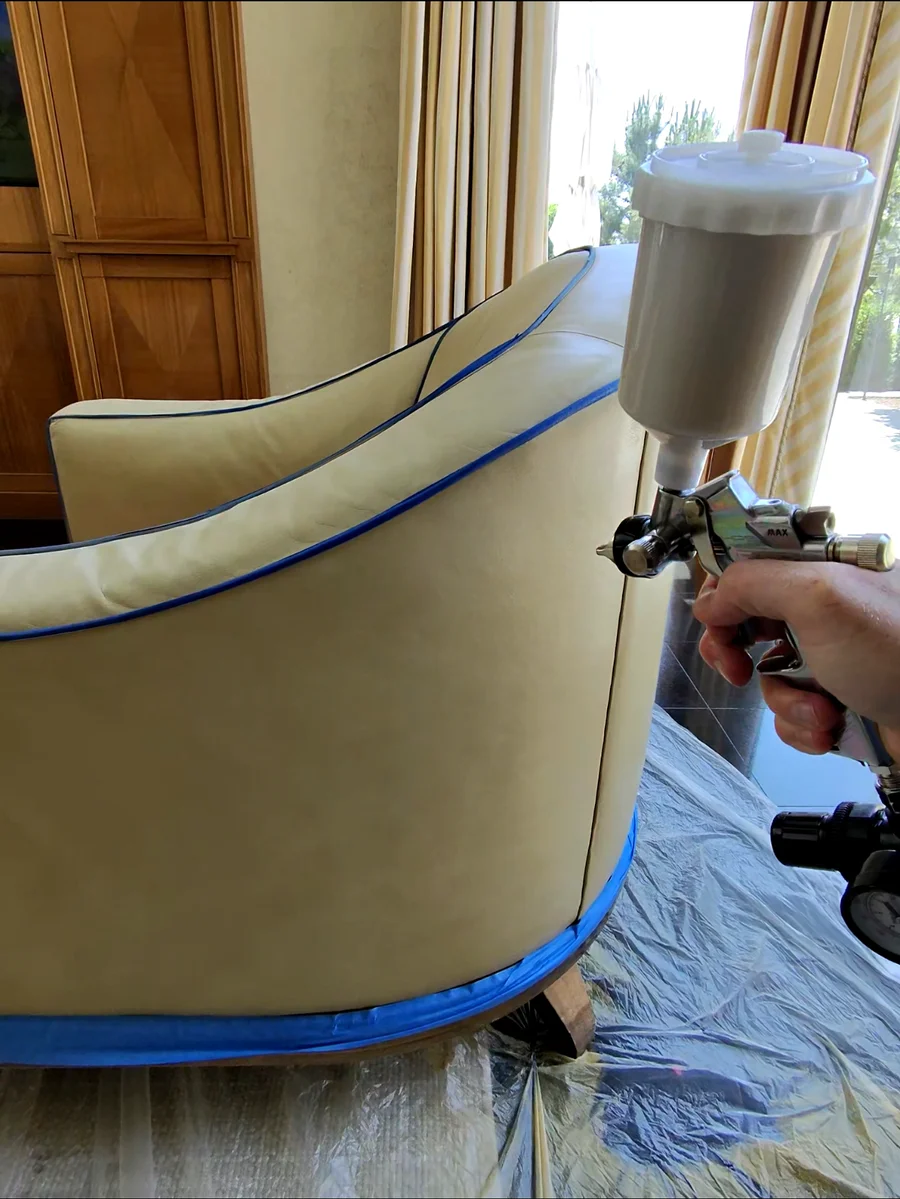
Masking tape protecting the white piping while color is sprayed onto the leather panels
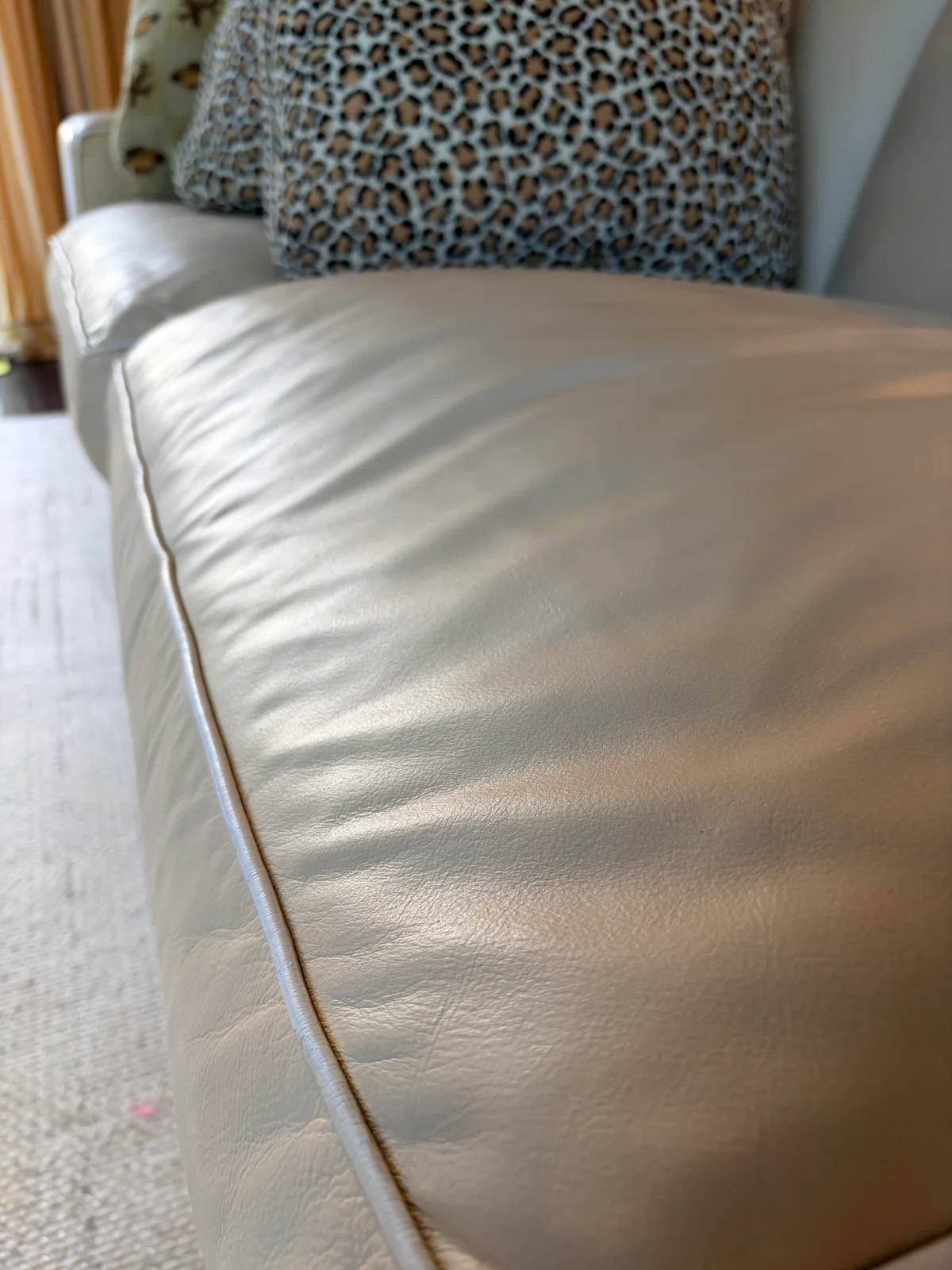
Cushion edge after restoration — white piping clean and defined against the refinished leather
The Finished Collection
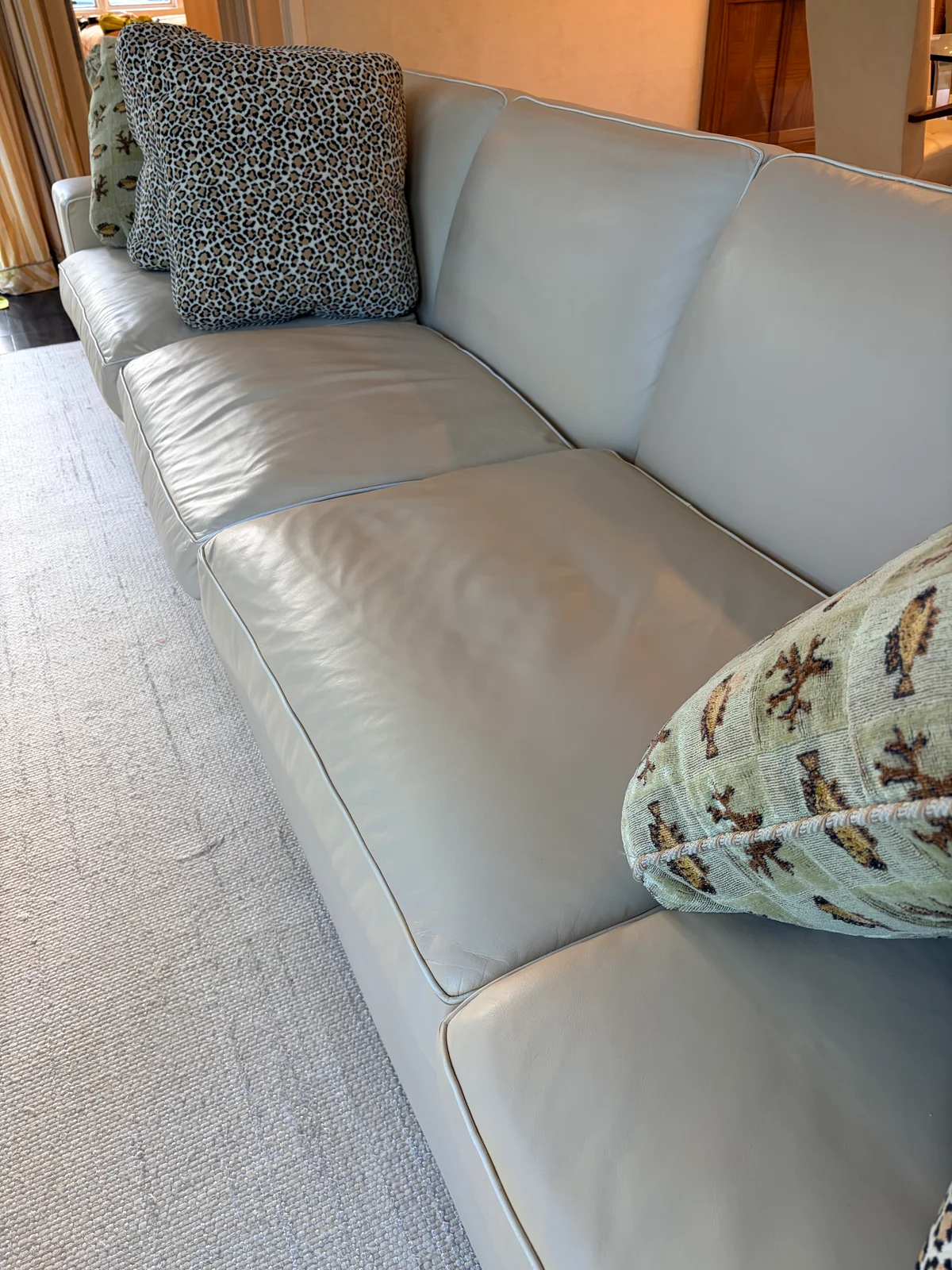
The sofa after restoration — custom color, crack-free surface, and white contrast piping preserved throughout
All three pieces — the sofa and both club chairs — were finished to the same custom color, producing a visually unified collection. The surfaces are smooth, with the crack network no longer visible. The leather has recovered a flexible, healthy character, and the finish sits at an appropriate sheen level consistent with the original furniture quality.
The white contrast piping is intact throughout — clean against the refreshed leather on every panel, on every piece. The design details the furniture was originally built around are legible again.
Placed back in the residence alongside the leather dining seating, the collection now reads as part of a deliberate, unified interior palette — which was the client's original intention and the defining brief of this project.
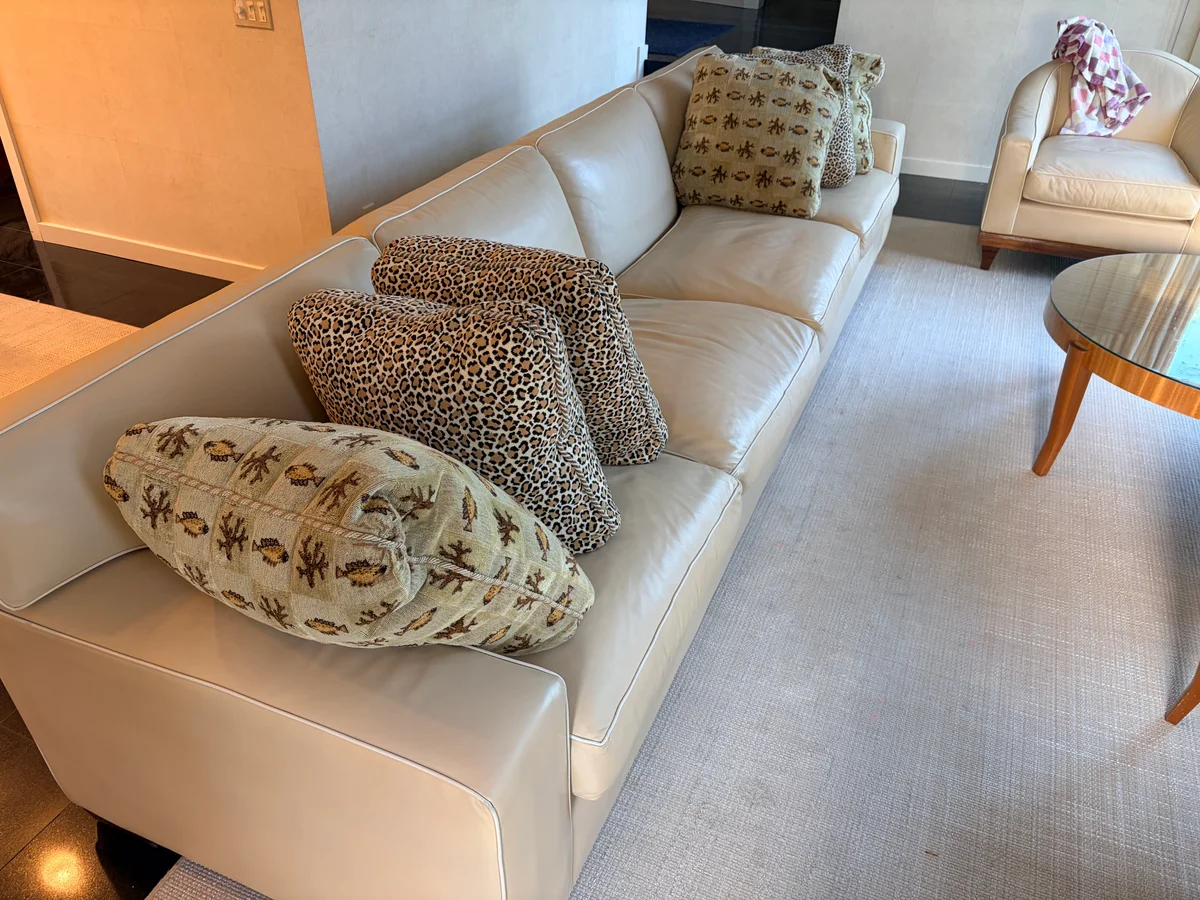
The restored collection — sofa and club chair unified in the custom color, with the dining seating coordination the brief required
Why Professional Leather Restoration, Not Replacement
For a luxury leather sofa and matching premium leather seating of this quality, replacement is rarely the straightforward solution it appears. Sourcing leather at the same grade and quality as the original is not guaranteed — and for a designer leather furniture collection designed to work together, matching both the leather character and the color across multiple replacement pieces adds significant complexity and cost.
More to the point: the leather on this furniture was not compromised. It was the finish — the protective and colorant layer applied over the leather — that had failed. The hide beneath retained its structural integrity. Replacing furniture because its surface finish has deteriorated discards material that can be professionally restored.
Restoration also allowed something replacement could not: the development of a custom color. A replacement upholstery job would produce furniture in whatever leather is currently available. This luxury leather seating restoration produced furniture in precisely the color the client needed to complete the interior as a coherent whole.
The result maintains the original designer leather furniture — its proportions, its materials, its design character — while correcting the visible condition and adding the color coordination that the brief required.
Original leather preserved
The hide was structurally sound. No leather was replaced.
Custom color developed
A specific tone was produced to coordinate with the dining area — not possible through replacement.
White piping retained
The defining design element of the collection was fully preserved through precision masking.
Three-piece collection unified
All three pieces received the same custom color, producing a coherent result across the full set.
Conclusion
This project combined the technical demands of a full leather restoration — cleaning, crack repair, and complete recoloring — with the design requirement of custom color development for interior coordination. The preservation of the original white contrast piping throughout added a further layer of precision to the work.
The furniture now reads as the client intended: a unified collection whose leather palette sits in deliberate relationship with the rest of the residence. The original leather — the material that gave the furniture its quality and character — is intact throughout.
If you have a leather sofa, chairs, or a furniture collection that requires professional color restoration, crack repair, or custom color development, contact us for a free assessment.
Frequently Asked Questions
Can sun-faded leather furniture be restored?+
Yes. UV fading affects the finish layer of leather, which can be professionally stripped, re-pigmented, and re-finished. When the leather substrate itself is structurally sound — no delamination or deep structural cracking — the original material can be preserved throughout. On this project, severe UV fading across a large sofa and two club chairs was addressed, restoring an even, healthy color and finish while retaining the original leather.
Can dried leather with surface cracks be repaired?+
Yes. Surface cracking in leather typically indicates finish failure and dehydration rather than structural damage to the leather substrate. After deep cleaning and surface preparation, a flexible leather filler is applied to the crack network, leveling the surface. Once the filler cures and is smoothed, the area accepts new color and top coat and integrates with the surrounding leather. The cracking disappears under the refinished surface.
Can leather furniture be professionally color matched?+
Yes. Professional leather color matching involves mixing flexible leather pigments to produce a precise match to the existing leather shade. For aged leathers, matching to the current color — which may have shifted significantly from the factory original — is the correct approach. Matching to the factory specification on aged leather would produce a visible mismatch. We mix on-site, test on an inconspicuous area, and apply only once the match is confirmed.
Can multiple leather furniture pieces be matched to a single custom color?+
Yes. This is a service we provide when a collection of furniture has aged unevenly, or when a client needs to coordinate pieces from different sources within the same interior. In this project, a sofa and two club chairs were fully recolored to a single custom-developed tone designed to coordinate with leather dining seating elsewhere in the same residence. The color blend is developed first, then applied consistently across all pieces in the collection.
Can original white contrast piping be preserved during leather restoration?+
Yes, but it requires precise masking. White contrast piping on leather furniture is typically a lighter leather cord — recoloring the main leather without affecting the piping requires careful masking with tape along every piping edge before any color is applied. This is applied to every cushion and panel on every piece in the collection. The process is time-consuming but essential: overspray onto white piping cannot be corrected without compromising the piping itself.
Is leather replacement always necessary for damaged furniture?+
No. Replacement is warranted when the leather substrate has delaminated, when structural stitching has failed beyond repair, or when damage is so extensive that filling and refinishing would not produce an even result. For cosmetic damage — fading, finish failure, surface cracking, color loss — professional restoration preserves the original leather while correcting the visible condition. Replacement at comparable quality is also significantly more expensive, and for designer or custom furniture, may not reproduce the original leather quality.
How long does professional leather restoration last?+
With proper maintenance, a professional leather restoration holds for many years. The critical factor is aftercare: leather should be cleaned with appropriate products and conditioned at regular intervals. The protective top coat applied at the end of restoration is the primary protection layer and should be maintained with a leather-specific cleaner. Avoid silicone-based conditioning products, which interfere with future restoration work, and protect leather from prolonged direct sunlight, which accelerates UV degradation.
What leather furniture is best suited to professional restoration?+
Sofas, armchairs, club chairs, sectionals, dining chairs, and ottomans with leather that remains structurally intact are good candidates. The key condition is that the leather substrate — not just the finish — is sound. Leather with severe delamination from its backing, or leather that has been allowed to completely desiccate over many years, presents more significant challenges and requires a professional assessment to determine whether restoration or replacement is the correct recommendation.
Restore your luxury leather furniture.
Free assessment · Custom leather color matching · On-site service across NYC